Contact 811 before digging, review all responses and ask the water utility which lines it marks. Hire a private locator for lines outside the utility’s scope. Records and meter locations are clues, not a confirmed route or depth.
Start with an 811 request
Before digging for a fence, planting, drainage or repair, contact 811 or submit a request through your state’s 811 center. Give the planned location and type of work, and follow that state’s notice, waiting and response requirements. They vary by location. The center notifies participating utility operators; it is not itself proof that every pipe on the property has been found.
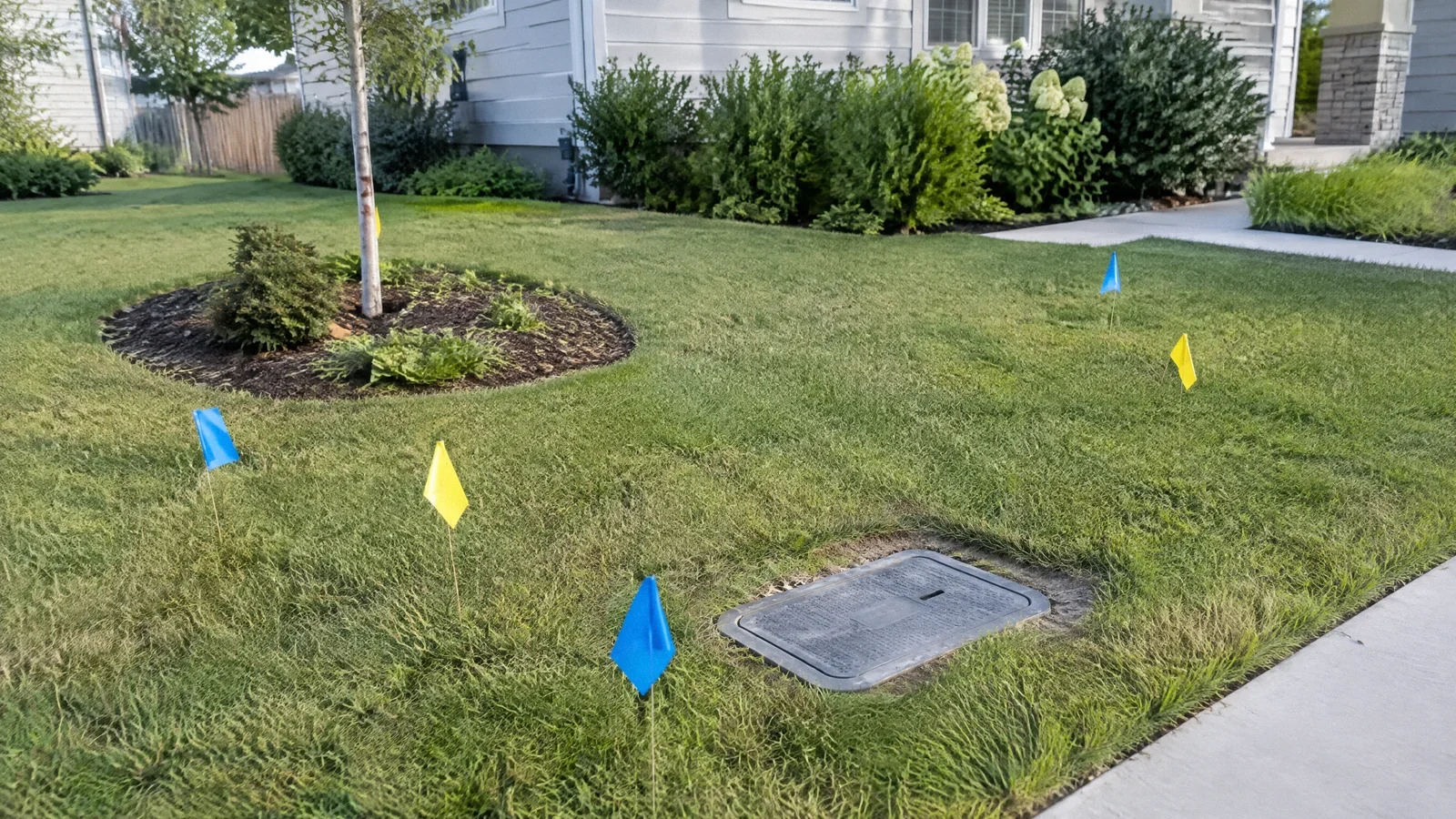
Wait for responses and review the ticket status before beginning. Marks or flags show approximate locations, not an exact surveyed depth or permission to dig carelessly. Preserve them throughout the work and follow local requirements for working near marked facilities. If a response is missing, unclear, or the marks have disappeared, contact the 811 center before proceeding.
Find out which lines the request covers
A public utility may locate only the facilities it owns or operates. Private water service, irrigation, a pool supply, a well line, or a line to an outbuilding may fall outside that scope. The boundary differs by utility and locality; do not assume the meter, curb, property line or house is always the dividing point. Ask the water provider specifically what it will mark.
Tennessee 811 and Indiana 811 both explain that private lines may not be marked through the ordinary notification process. If a line is private or its ownership is uncertain, arrange a private utility locator or a qualified contractor with appropriate locating equipment. Provide the 811 responses and describe every known private system. A private locate supplements rather than replaces the required 811 request.
Use records and visible clues as leads
Collect the property survey, construction drawings, permits, irrigation plans, well records and records of past repairs if available. Ask the water utility or previous owner whether they have a service sketch. Locate the meter box, shutoff valve, well equipment and the point where a supply pipe enters the house, where these are visible and safely accessible.
These clues can suggest a route, but they do not prove a straight path between the meter and house. Pipes may turn around trees, foundations or other buried services; repairs and additions may not appear on older plans. A meter box is not a safe digging target by itself. Treat records and landmarks as information for the locator, not as a map accurate enough for excavation.
Ask how the locator will identify the pipe
A private locator may use different methods depending on pipe material and access. Metallic pipes can sometimes be traced with suitable electronic equipment. A nonmetallic water pipe without a tracer wire can be harder to find; the locator may need to assess available access and choose another method. Ground conditions, nearby utilities and depth affect results.
Ask what was actually traced, where the locate is uncertain, whether the full route was covered and how results are documented. A line on a drawing or a signal from nearby metal is not necessarily identification of the water pipe. Do not infer depth from flag spacing or color. If results conflict with records or site conditions, resolve the discrepancy before excavation.
Plan the work around all buried services
Water is only one possible hazard. Electric, gas, communications, sewer and other facilities may occupy the same area. Review every response and any private-locate findings with the person performing the excavation. Local rules define how to work near marks and what methods are allowed; a contractor can explain the applicable tolerance zone and safe exposure procedure.
If a line is hit or a release is suspected, stop work, move away and notify the relevant utility. If there is a gas release or immediate danger, get clear and call 911. Do not attempt to repair a damaged gas or electrical line. Follow responders’ instructions and keep others away.
Keep a useful record
Photograph marks with fixed landmarks before they fade, retain the locate ticket and private locator’s report, and note the date and scope. If a contractor confirms a line during permitted work, ask for a record of its observed route. Measurements and photographs can help future planning, but should not be treated as a substitute for a fresh locate request before another project.
If the purpose is leak repair rather than excavation, tell the plumber about changes in pressure, wet ground or a high bill. These symptoms may help identify a problem but do not establish the exact location of the water line or leak. Have the system assessed before opening the ground.
Your next-step checklist
- Submit a state 811 request before digging.
- Review all responses and protect marks.
- Ask the utility which facilities it locates.
- Arrange a private locate where needed.
- Resolve uncertain or conflicting information before excavation.
Related questions
Does 811 mark every water pipe on my property?
Not necessarily. Private service, irrigation, well and other lines may be outside participating operators’ responsibilities. Ask the utility and arrange private locating where needed.
Can I draw a straight line from the meter to the house?
No. A route can turn or have been changed. Use a qualified locator and treat plans as leads.
Do flags show exact pipe depth?
No. Marks generally indicate approximate horizontal location; depth is not established by the flags.
Sources & context
Public guidance supports the principles in this article. The practical questions and examples are editorial interpretation, not a site assessment or a coverage decision. State-specific rules apply only where identified.
- Before You Digprimary
- Private Locatesprimary
- Locate Lines Before Diggingprimary