Compare the exact model’s height, width and outlet locations with the space under your sink. Check the drain, dishwasher hose, mounting system and service clearance; a matching sink opening alone does not guarantee a fit.
The dimensions that determine fit
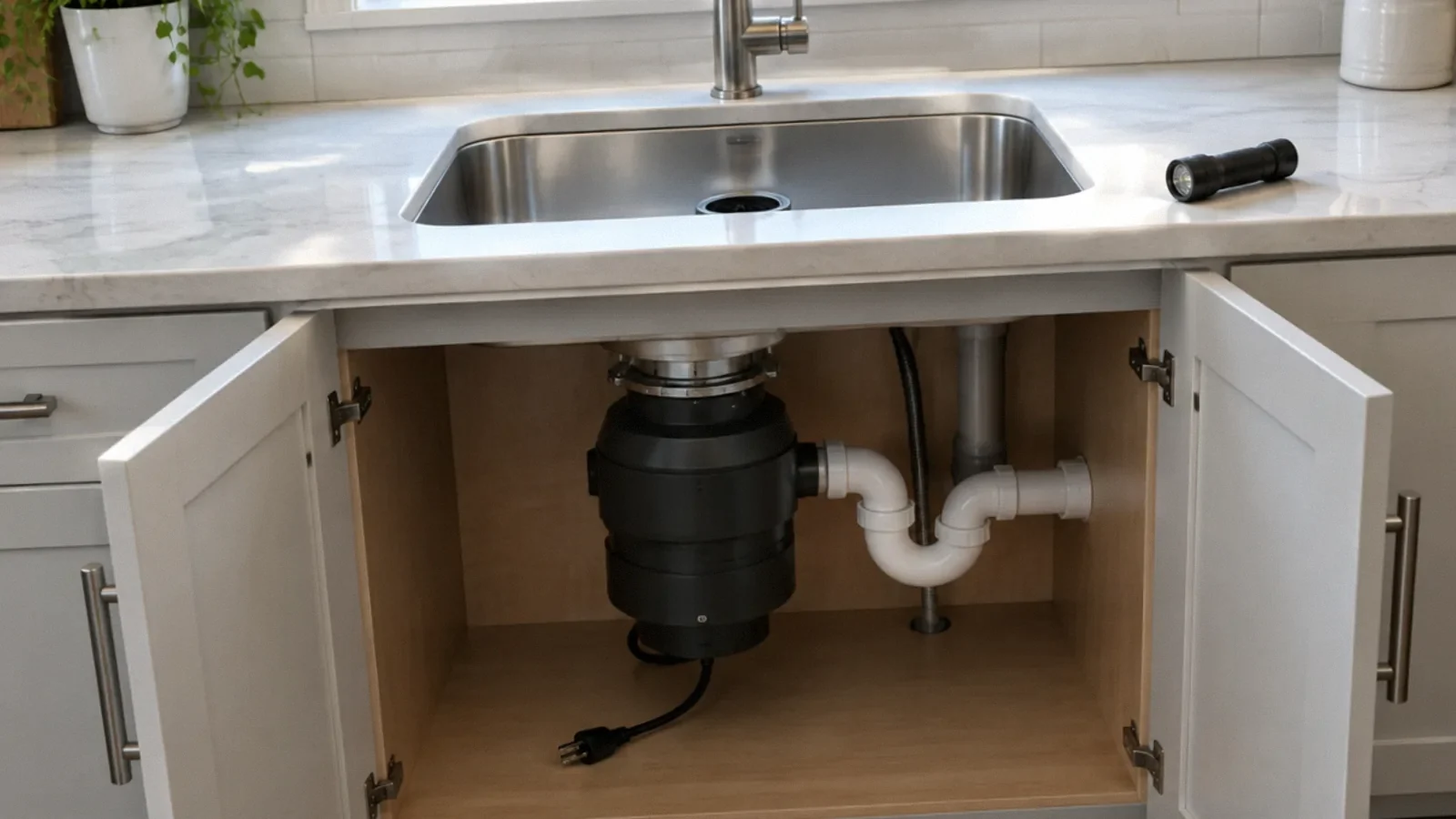
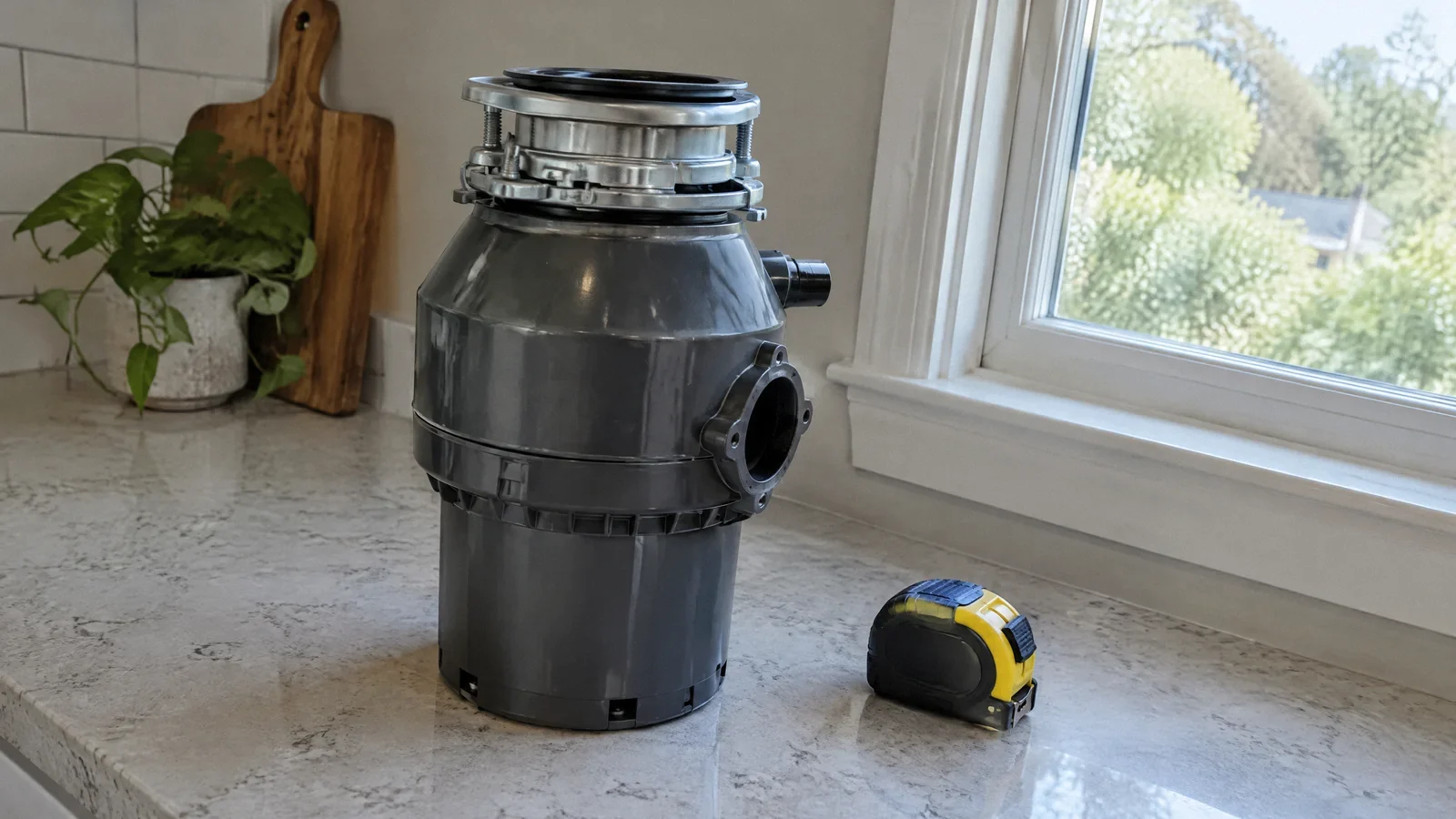
A garbage disposal hangs below the sink, so the sink opening is only the beginning of a fit check. Measure the space below the sink, the unit’s overall height and width, the drain outlet location and the dishwasher connection if used. Compare these measurements with the drawing for the exact model. Moen identifies three useful reference dimensions: from the top of the disposal to the dishwasher connection, to the drain outlet centerline and to the bottom of the unit. A unit that physically fits in the cabinet can still be incompatible with the drain arrangement.
Measure height beneath the sink
With the cabinet empty enough to see clearly, measure the vertical space below the sink bowl and mounting area. Note shelves, cabinet floor, water lines, shutoff valves and any filtration equipment. Compare that space with the manufacturer’s drawing and note where its measurement begins: the top of the unit, the sink bottom or another reference. The sink’s depth and mounting assembly affect the space left beneath it. Leave room for installation, service and the reset or jam-clearing features as specified by the manufacturer. Do not assume the height printed in a shopping listing includes every fitting.
Check width and depth
Measure across the available area as well as from front to back. The disposal body may be wider below the mounting ring, and an outlet elbow can extend beyond the body. Include space for the drain trap, dishwasher hose, supply lines and items such as a water filter. A cabinet can be wide enough overall while a pipe or shelf blocks the particular part of the space the disposal needs. Compare the drawing and the actual orientation of the connections before choosing a compact model solely by its advertised width.
Locate the drain discharge
The outlet’s height relative to the wall drain is especially important. Measure from the drawing’s stated reference point to the centerline of the disposal outlet, then compare the proposed position with the existing drain arrangement. Moen’s model-specific drawings provide this dimension and may include an allowance for sink material. A deeper sink or taller mounting assembly can change where the outlet sits. The drain still needs a suitable path and trap under applicable local requirements. If the outlet and wall drain do not align, a plumber should assess the available options rather than forcing the assembly or assuming a flexible fitting is acceptable.
Allow for the dishwasher connection
Many disposals have an inlet for a dishwasher drain hose, but its presence, size and position are model-specific. Check the manufacturer’s drawing and the dishwasher’s instructions, including any required air gap or high loop and local requirements. Leave enough room for the hose and its bend without kinking it. Some units have a removable knockout plug at the inlet; removal is relevant only when connecting the dishwasher and must follow the product instructions. An omitted or improperly handled plug can interfere with drainage. A new disposal should not be selected on the assumption that every dishwasher hose connects identically.
Confirm the mounting and sink
Check the exact mounting system, sink opening, sink material and maximum thickness against the product specifications. A disposal that fits an opening is not necessarily compatible with an existing mounting assembly or thick sink. Some models require a different flange or additional parts. For example, a Moen specification lists a maximum sink thickness for that model; it should not be treated as a limit for every disposal. If the sink manufacturer restricts disposal installation or the mounting area is damaged, resolve that before purchase.
Electrical and service access
Identify whether the model has a cord, requires a compatible outlet or needs a different electrical connection. Follow the unit’s instructions and local requirements, and use a qualified electrician where needed. Do not add an extension cord under the sink or work on a live circuit. Check that the unit can be supported and rotated into its mount, and that the reset button and any service opening remain accessible. Clearance for a hand or tool matters even when the disposal itself just fits between the cabinet floor and the sink.
Use the actual manufacturer drawing
Product specifications vary between models, even within one brand or horsepower class. For example, Moen’s Chef Series drawing identifies overall dimensions and the distance from the sink bottom to the discharge centerline, including a sink-specific note. Read the revision and drawing for the actual model you intend to buy. A photograph of a different installation or a generic diagram cannot establish fit. Keep the sheet with the model number and bring your cabinet measurements to an installer or retailer for a compatibility check.
Before ordering and after installation
Measure twice with the existing trap, dishwasher hose, valves and any shelving visible. Record the sink bottom, cabinet floor and drain connection locations, then compare the complete assembly with the selected model’s instructions. Ask about parts and potential drain modifications before ordering. After installation, the installer should check the sink connection, dishwasher inlet and drain joints for leaks under normal use. If the existing unit is jammed or not working, sizing a replacement is a separate decision from safely diagnosing the old unit. Never put a hand into a disposal while it can be powered.
Your next-step checklist
- Measure available height, width and depth under the sink.
- Compare the drain outlet centerline with the existing drain.
- Check dishwasher inlet and hose clearance.
- Confirm sink thickness and mounting compatibility.
- Allow for electrical and service access.
Related questions
Do all garbage disposals have the same dimensions?
No. Height, body width, outlet position and mounting details vary by model.
Does a matching sink opening guarantee the unit fits?
No. Cabinet clearance, sink thickness, mounting and drain arrangement must also be checked.
Why does drain outlet height matter?
It determines where the disposal connects relative to the existing drain and trap. A plumber can assess whether the arrangement is suitable.
Must every dishwasher plug be removed?
Follow the specific model instructions. A knockout plug is relevant when using that inlet for a dishwasher connection; do not alter an unused inlet without instruction.
Sources & context
Public guidance supports the principles in this article. The practical questions and examples are editorial interpretation, not a site assessment or a coverage decision. State-specific rules apply only where identified.