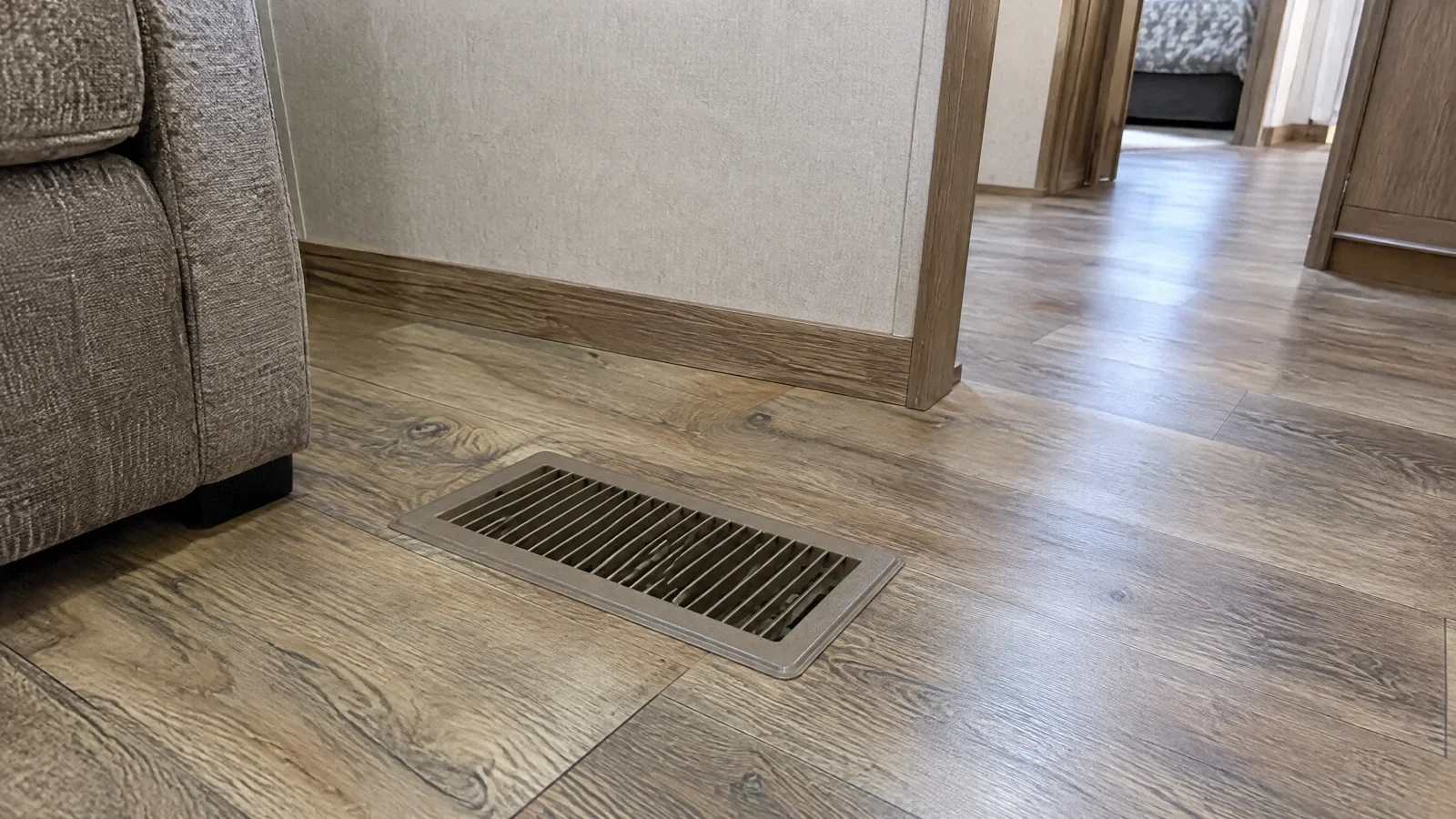
Start inside the home: compare airflow at accessible registers and look for dust, damaged grilles or unusual odors. A qualified HVAC contractor can inspect the duct connections, crossover and underbelly safely and perform a leakage test. Weak airflow alone does not prove that a duct is leaking.
Understand where the ducts may run
Manufactured homes often have a main supply duct below the floor, with short connections to floor registers. Some use ceiling or wall registers. In a multi-section home, a crossover duct may connect one section to another beneath the home. Layouts vary: consult the home’s documentation or ask a technician to identify the supply, return and crossover before drawing conclusions.
A leak can waste conditioned air and affect comfort. In some hot, humid climates, leakage and pressure differences can contribute to moisture problems. DOE research describes leaks at connections between the air handler, main trunk, register boots and crossover. Those are useful inspection targets, but a location on a checklist does not prove a fault exists in your home.
Start with observations inside
With the system operating normally, walk through rooms and compare the air coming from accessible supply registers. Note a room that receives much less air than it used to, temperature differences, rattling, or a sudden increase in dust. Make sure furniture, rugs and closed dampers are not blocking the registers. A clogged filter, equipment problem or a closed interior door can also affect comfort, so weak airflow by itself is not a diagnosis of duct leakage.
Look at each visible grille and the surrounding floor for gaps, loose fasteners, water staining or damaged flooring. Take photographs and write down which rooms are affected. Do not insert your hand or tools into a duct, remove inaccessible panels, or disturb insulation. If a grille is damaged or the floor is soft, have a professional assess it instead of forcing it open.
Compare conditions and note when they occur
Observe whether the issue occurs during heating, cooling or both, and whether it changes when doors are open. A room may be uncomfortable because of insulation, solar exposure, a blocked return path or equipment settings rather than a broken duct. Record the thermostat setting, filter condition and the date the issue started. These details help a contractor reproduce the problem.
A musty smell, visible moisture near a register or recurring condensation merits investigation of the moisture source as well as the duct. Odor alone cannot identify mold or establish the extent of contamination. Do not spray fragrances or seal over a wet surface to conceal it. If the area is wet or deteriorating, keep occupants away from the affected material and arrange a professional assessment.
Why the underbelly and crossover matter
The underbelly is the protective material beneath many manufactured homes. Tears, sagging insulation, disconnected ductwork or openings around penetrations may signal a need for inspection. In a multi-section home, the crossover between sections can be crushed, disconnected or poorly supported. These conditions can be hidden, so an intact-looking room does not establish that the entire system is sound.
Do not crawl beneath a home into a tight or unsafe space. Exposed wiring, pests, sewage, unstable supports, damaged insulation and sharp metal are possible hazards. Do not cut the underbelly yourself to look for ducts. A trained contractor can decide whether access is safe, inspect the connections and restore the protective layer after a repair.
Ask for an HVAC inspection and leakage test
An HVAC contractor or qualified energy assessor can examine the air handler connections, supply trunk, register boots and crossover where accessible. Ask them to check for disconnected, crushed or kinked flexible duct; loose seams; inadequate support; and damage to the underbelly. Ask what they can and cannot see, and request photographs of concealed defects.
A duct leakage test uses equipment to pressurize the distribution system and measure air loss. The test can help establish whether leakage is significant and whether repair improved it. Its result needs interpretation in the context of the home and test method; it does not identify every cause of poor airflow by itself. Airflow, equipment condition and return pathways may need separate evaluation.
Choose repairs that address the cause
The remedy depends on what is found. A disconnected crossover may need proper reconnection and support; a crushed or torn flexible section may need replacement. Leaky seams and boot connections may need an approved duct sealing product installed on a suitable surface. The contractor should follow the product instructions and applicable standards, and should repair any underbelly or insulation opened for access.
Ask for the scope in writing: which ducts will be repaired, how access and underbelly repairs will be handled, and whether a post-repair test is included. Do not assume ordinary cloth duct tape is a durable repair. Avoid covering over wet material or sealing a system without first addressing the source of moisture.
When to stop and get help promptly
If you smell gas, leave the building and contact the gas utility or emergency services from a safe location. Do not operate switches or attempt to locate the leak. A burning smell, smoke, exposed wiring or visible sparking also calls for stopping use and seeking appropriate emergency or professional assistance.
If there is sewage, standing water, damaged structural support or extensive deteriorated material beneath the home, tell the contractor before scheduling entry. The duct work may need to wait until the hazard has been assessed. Ask a qualified specialist to determine whether affected materials can be cleaned or need replacement.
Verify the result
After repair, review photographs and the service report. If testing was part of the scope, compare before and after results using the same method and ask what the numbers mean. Check whether the underbelly and insulation were restored and whether the contractor addressed the original room-level symptoms.
Keep a record of the work and continue routine filter changes according to equipment instructions. If airflow or moisture problems persist, report the same observations to the contractor. A duct repair can solve a leakage problem without necessarily resolving unrelated equipment, building or moisture defects.
Your next-step checklist
- Document weak airflow and affected rooms.
- Check accessible registers for obstruction or damage.
- Keep out of unsafe crawlspaces and avoid cutting the underbelly.
- Request inspection of boots, trunk and crossover as applicable.
- Ask for photos and a post-repair test when appropriate.
Related questions
Does weak airflow mean a duct has come loose?
Not necessarily. A blocked register, filter, equipment issue or return-air restriction can also affect airflow. An inspection can identify the cause.
Can I inspect beneath the home myself?
Avoid entering a tight or hazardous under-home space. A qualified contractor can assess access, inspect the ductwork and restore disturbed protective materials.
Should every duct system be cleaned?
Inspection and diagnosis come first. Cleaning is not a substitute for repairing leaks, disconnected ducts or moisture sources.
Sources & context
Public guidance supports the principles in this article. The practical questions and examples are editorial interpretation, not a site assessment or a coverage decision. State-specific rules apply only where identified.