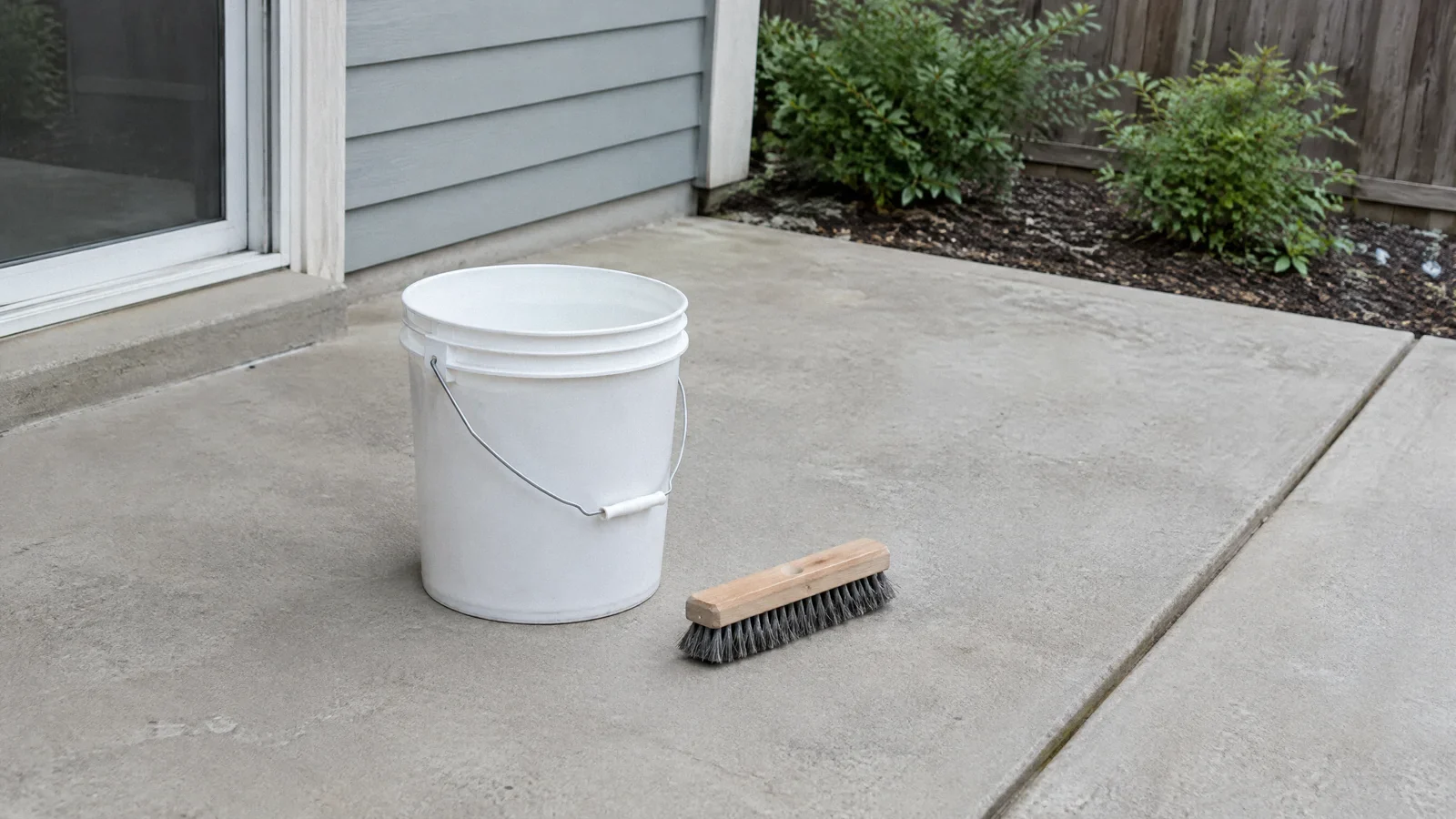
For ordinary dirt, start with a concrete-compatible detergent and water. Use bleach only if its label and the surface manufacturer permit it, and follow the label’s dilution, protection, ventilation and disposal directions.
Decide whether bleach is needed
Concrete is porous, and discoloration can come from soil, oil, rust, mildew or a coating failure. Bleach is not a universal degreaser or a repair for a damaged slab. Start by sweeping loose dirt and washing a small test area with a cleaner appropriate for the surface. If a stain remains, identify it before choosing a specialty cleaner. A dark mark alone does not establish that mold is present.
Check the surface and product labels
Read the concrete, sealer and bleach labels. Decorative, stained, painted or sealed concrete can change color or lose its finish. If either manufacturer advises against bleach, choose an approved alternative. Test an inconspicuous area and allow it to dry before proceeding. A label that does not list concrete or give a suitable use does not provide a reliable recipe for that job. Do not improvise a stronger solution.
Protect people, plants and drains
Wear the gloves and eye protection required by the label and provide fresh air. Keep children and pets away during application and until the treated area is safe under the directions. Plan where the rinse water will go before starting: do not send chemical runoff into a storm drain, stream, pond or garden. Check local disposal requirements and the product instructions. For a large exterior area, a professional may have the equipment to control runoff.
Never mix cleaners
CDC warns never to mix bleach with ammonia, acids or other cleaning products because dangerous gases may be released. This includes vinegar, toilet cleaners and products whose contents you do not know. Do not use bleach on a surface that still has another cleaner on it. Follow the earlier product’s complete removal directions first, rinse and allow the surface to dry as directed. If fumes cause irritation, leave the area and seek appropriate help.
Use only the labeled procedure
If the label explicitly permits the intended concrete application, dilute with water only as directed, use a suitable nonmetallic container if the label specifies one, and apply the amount it calls for. Avoid splashing or creating a fine mist. Work in manageable sections with a brush suitable for the finish, without grinding the surface. Follow the stated contact time and rinse requirements. Do not let bleach dry on the surface unless the manufacturer explicitly directs that procedure.
Clean up and assess after drying
Collect and dispose of the solution and rinse water according to the label and local requirements. Clean tools as directed and store the original container securely. The concrete may look different when wet, so let it dry before judging the result. If the stain remains, repeated stronger treatments can damage finishes without resolving its cause. Oil, rust and mineral deposits may need different approaches or an experienced concrete-cleaning contractor.
Indoor slabs and moisture problems
For an indoor slab, ventilation and runoff control are especially important. Do not use bleach in an enclosed area where adequate ventilation cannot be provided, or where water could reach electrical equipment. A persistently damp slab or mold on nearby porous flooring calls for moisture investigation, not repeated bleach washes. If sewage or floodwater is involved, contact a professional experienced with contaminated water.
Prevent the stain from returning
Correct drainage or leaks, keep organic debris from collecting and follow the surface manufacturer’s maintenance recommendations. A compatible sealer may help some surfaces, but first confirm that the slab is dry enough and suitable for that product. Keep a record of the cleaner and test location so a future treatment does not accidentally combine incompatible products.
A worked decision for a patio
Suppose a small outdoor patio has ordinary dirt near a doorway and a separate orange stain near a metal chair. Begin with a concrete-compatible detergent and a brush appropriate for the finish, then rinse only as permitted by the label and local runoff rules. Let the test area dry. If the ordinary soil improves but the orange mark remains, do not increase the bleach concentration or combine products. The mark may require a different treatment, and a decorative finish may limit what can be used. Ask the surface manufacturer or a concrete specialist to identify a compatible cleaner. If disinfection is actually needed, use a product labeled for that purpose on the surface and follow its separate directions for cleaning, application and contact time. These are distinct tasks: a cleaner that changes a stain’s appearance does not establish that disinfection has occurred. Keep all products in their original containers and store them securely.
Your next-step checklist
- Decide whether bleach is needed
- Check the surface and product labels
- Protect people, plants and drains
- Never mix cleaners
Related questions
Should I ignore the manufacturer’s directions?
No. Follow the instructions for your specific surface or machine and product.
When should I call a professional?
Stop if the problem involves inaccessible components, persistent damage, or conditions you cannot safely assess.
Sources & context
Public guidance supports the principles in this article. The practical questions and examples are editorial interpretation, not a site assessment or a coverage decision. State-specific rules apply only where identified.