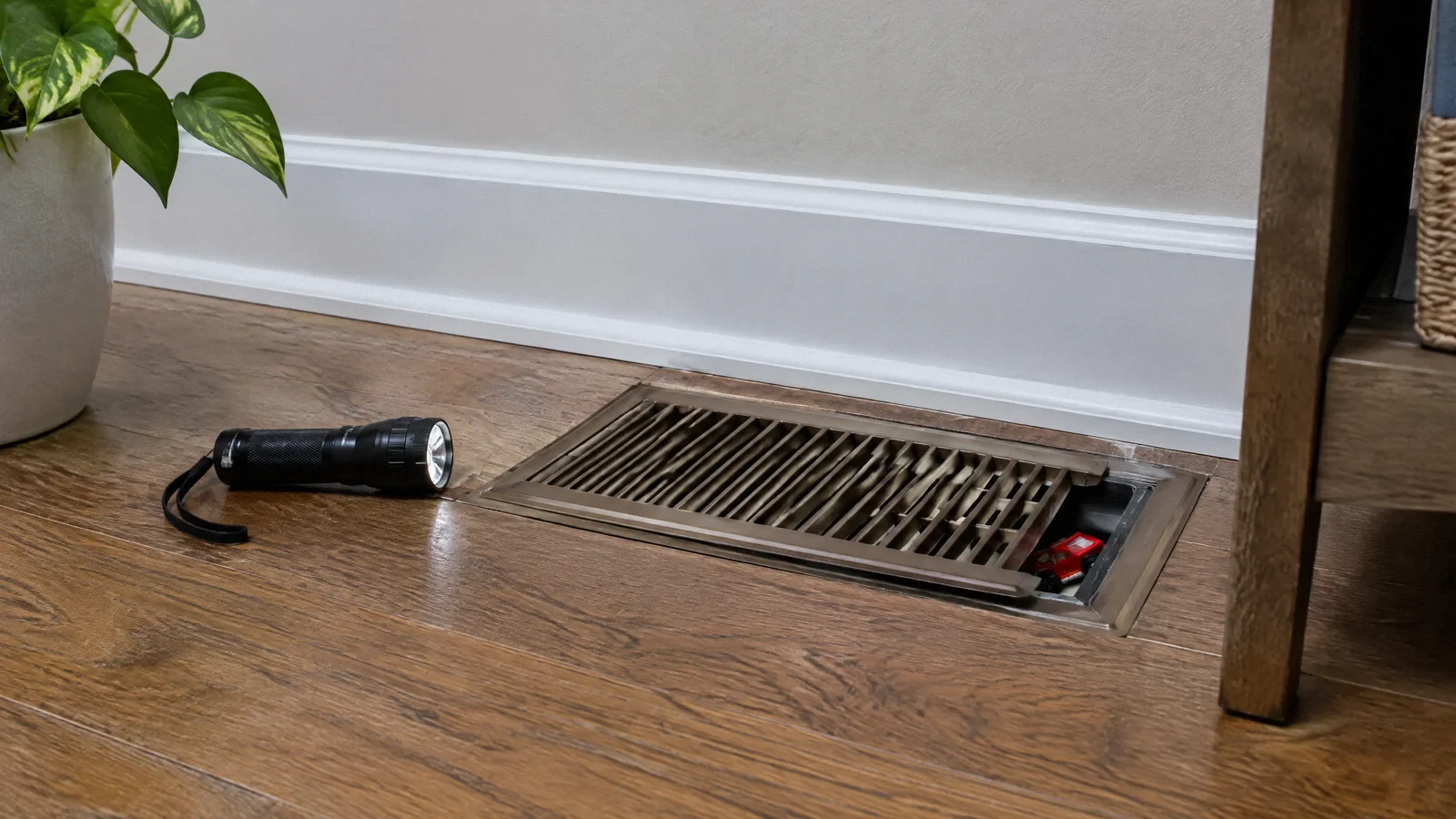
Turn the HVAC system off at its normal control, inspect with a flashlight and remove a safely accessible grille if designed for removal. Retrieve only an object you can see and reach without force; call an HVAC technician if it is deeper or hazardous.
Confirm what kind of vent you are dealing with
This guide concerns a room register or return grille connected to a home heating and cooling system. A dryer exhaust, combustion flue, plumbing vent or other opening is a different system with different hazards. Do not apply these instructions to a gas appliance, chimney, roof vent or electrical equipment. Contact the appropriate technician if the opening is not clearly an ordinary room HVAC register.
Keep children and pets away from the opening and note what fell in and when. If a button battery or small magnet might have been swallowed rather than dropped, do not spend time searching the vent first: seek immediate medical attention. The Consumer Product Safety Commission warns that swallowed button batteries can cause severe injury quickly.
Stop airflow and inspect without reaching deeply
Turn the heating and cooling system off at its normal control so airflow does not move a lightweight item farther into the duct. If the equipment continues to run or you cannot identify the control, contact building maintenance or an HVAC technician. Do not open the air handler or touch wiring, fan components or electrical connections.
Use a flashlight to look through the grille. Note whether the item is actually visible, whether the opening is in a floor, wall or ceiling, and whether it rests close to the opening or beyond a bend. A phone camera may help document the location without reaching inside. Avoid pushing the object while investigating.
Remove an accessible register only if safe
Some floor registers lift out; others are secured with screws. If the grille is safely accessible and designed for removal, remove it carefully using the appropriate hand tool and put screws in a container. Support a wall or ceiling grille so it does not fall. Do not stand on an unstable chair or ladder or pull on a grille that is painted in place, damaged or difficult to reach.
Edges of sheet metal can be sharp. Wear suitable gloves and keep fingers clear of moving dampers. If the grille, insulation or surrounding material appears damaged or suspect, stop. EPA notes that some duct components can contain asbestos and should not be disturbed except by specially trained and equipped contractors.
Retrieve an item you can see and reach
If an ordinary solid item is clearly visible close to the opening and can be grasped without entering the duct, use a suitable long-handled grabber or tongs. Move slowly and support the object so it does not slip farther inside. A magnet can help with a ferrous metal item, but only if it is securely attached to its retrieval tool; many objects are not magnetic.
For a small lightweight item, a vacuum hose with a secured mesh barrier over the end may help hold the item at the opening. Check the barrier is firmly attached and cannot be sucked into the duct. This is only appropriate when the item is visible and the duct material will not be damaged. Avoid vacuuming liquids, broken glass, hazardous material or a battery.
Know when to stop
Stop if the object disappears around a bend, falls farther in, is sharp or fragile, is lodged behind a damper, or cannot be removed without force. Do not push rods or improvised hooks blindly through a duct. Flexible ducts and internal liners can tear, and a tool or loose magnet can become a second lost object. Do not cut access holes or enter a duct.
For a leaking battery, broken glass, spilled chemical, suspected pest or unknown substance, avoid contact and arrange appropriate professional help. An HVAC technician can determine whether an existing access point is available or whether controlled access and subsequent sealing are required. Tell them the item, approximate size, location and any unsuccessful attempts.
Reinstall and check the register
Once the object is recovered, check the visible opening for loose debris or damage without reaching into inaccessible parts. Reinstall the grille in its original orientation and secure it as designed. EPA’s duct-cleaning checklist calls for registers and grilles to be firmly reattached after work. Keep the opening covered while awaiting a replacement for a damaged grille.
Turn the system back on using its normal controls and observe whether the grille is secure and airflow sounds normal. If you hear a new rattle, smell burning or suspect a damaged duct, turn the system off and call a technician. Do not operate the system with a loose cover or tools left in the opening.
Prevent another dropped item
Replace loose or damaged registers with correctly sized covers appropriate for the system. Avoid placing toys, keys or small objects on top of floor grilles. A very fine screen or improvised filter can restrict airflow and collect dust, so consult the HVAC manufacturer or technician before adding one.
If you rent, contact the owner or building manager before modifying a grille or duct. Keep a photo and description of an unrecovered item for the technician. A lost object does not automatically mean the entire duct system needs cleaning; EPA says the need for duct cleaning depends on the conditions present.
Your next-step checklist
- Confirm the opening is a room HVAC register.
- Turn off the system and inspect with a flashlight.
- Remove an accessible grille carefully and keep fasteners safe.
- Retrieve only a visible, reachable object without forcing tools.
- Reattach the grille and call a technician for inaccessible or hazardous objects.
Related questions
Can I put a long stick into the duct to find the item?
Avoid probing blindly. It can push the item farther away or damage flexible ductwork or lining. Call a technician if it is out of sight or reach.
Should I remove the cover from a gas flue?
No. This guide applies to room HVAC registers, not combustion vents or flues. Contact the appropriate qualified technician.
Sources & context
Public guidance supports the principles in this article. The practical questions and examples are editorial interpretation, not a site assessment or a coverage decision. State-specific rules apply only where identified.
- Should You Have the Air Ducts in Your Home Cleaned?government
- HVAC Duct Terminal Sizinggovernment
- Button Cell and Coin Batteriesgovernment