A laundry-to-landscape system can direct suitable washing-machine wastewater through a diverter toward either the sewer or an appropriate landscape distribution area. The diagram is not an installation plan. Graywater is not drinking water, and design and permit requirements depend on the actual system and local authority.
Read the simple diagram
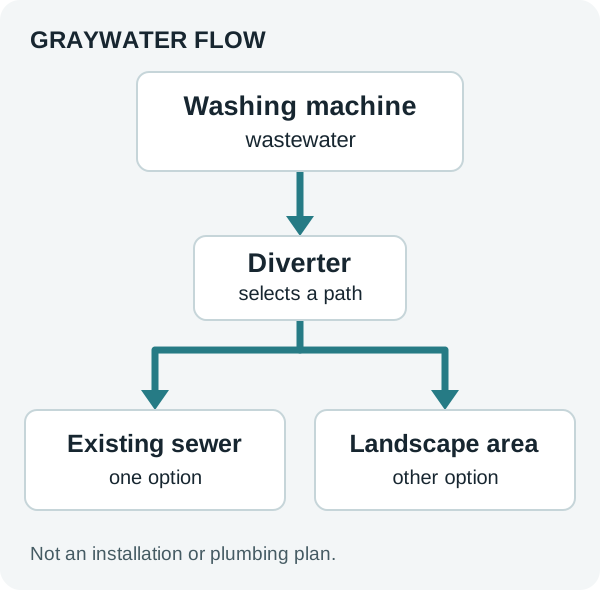
The diagram below shows three ideas: water leaves the washing machine, a diverter selects a path, and that path leads either to the existing sewer or to a suitable landscape distribution area. The branches illustrate alternatives, not simultaneous operation or a specific physical pipe layout.
East Bay Municipal Utility District (EBMUD) publishes a detailed laundry-to-landscape example in the sources. Its diagram includes site and component details that this simplified illustration intentionally omits. Consult the current local requirements and a qualified professional before construction.
What is graywater?
California’s Department of Water Resources describes graywater as wastewater from sources that can include showers, bathroom washbasins, clothes washers and laundry tubs. Under the California definition cited by the department, kitchen sink and dishwasher wastewater are not graywater. Definitions and permitted uses differ by jurisdiction.
Graywater is not potable water. It can contain detergents, dirt and microorganisms, and a reuse system must prevent exposure and contamination. Toilet wastewater is not part of the simple laundry example described here.
What does a diverter do?
In EBMUD’s laundry-to-landscape description, a three-way diverter directs washing-machine discharge either to the landscape system or to the sewer. This choice can be useful when weather or wash contents make landscape application inappropriate. The correct components and installation depend on the site and current requirements.
A flow diagram cannot establish that a particular valve, air gap, connection or washer is suitable. Do not connect graywater to a drinking-water line or improvise plumbing based on a generic picture. Ask the local building authority and an experienced installer about the actual configuration.
How does the landscape side work?
EBMUD’s example distributes water through tubing to planted landscape areas and uses mulch basins. The agency states that graywater must be applied subsurface and remain on the property without runoff. Soil, slope, plant selection and local conditions affect whether a system can work at a particular site.
The simplified diagram does not specify outlet spacing, pipe sizes, setbacks or capacity. Those details need a site-specific design and current local guidance. Do not direct water toward a foundation, neighboring property, drain inlet or location where it can pool or expose people and pets.
Choose the sewer path when appropriate
Laundry products and wash contents matter. EBMUD advises selecting suitable products and using the sewer path for certain loads, including diaper wash water, rather than sending that water to the garden. Follow the current utility guidance and the product label for your situation.
Rainy weather, saturated soil, maintenance or a system malfunction can also be reasons to stop landscape distribution. A working diverter and a usable sewer path should be part of the approved design; do not assume that the diagram alone proves an existing installation can safely switch paths.
Permits and local rules
California guidance describes a limited permit exemption for certain qualifying single-family clothes-washer systems, subject to conditions. It is not a blanket exemption for all graywater projects. Other sources, alterations, local rules, property conditions or uses can change the requirements.
Before work, ask the local building or environmental health authority and water provider about the proposed system, current California Plumbing Code provisions, permits, inspection and any property-specific restrictions. Check separately for homeowners association or landlord authorization where applicable.
Prevent leaks and water damage
Inspect accessible components for leakage, unusual odors, standing water or runoff. Stop using the landscape path and arrange qualified service if the system appears damaged or water is moving toward a structure. Stay away from water near electrical equipment and do not enter an unsafe crawl space or confined area.
If water has affected building materials, the source and affected area need assessment and appropriate cleanup. Do not treat wastewater as clean drinking-water leakage. A professional can assess contamination, hidden moisture and repairs.
Questions to ask before installation
Ask where the washer discharge comes from, how the system avoids a cross-connection with drinking water, where the sewer and landscape branches go, and how the system can be inspected or serviced. Request a written plan that reflects the actual property and local requirements.
Keep the owner’s instructions and explain the diverter positions to household members. Review maintenance, suitable detergents, seasonal operation and what to do when a load should not go to the landscape. A diagram helps with the conversation but cannot replace that plan.
Your next-step checklist
- Treat graywater as nonpotable wastewater.
- Use the diagram as a concept, not an installation design.
- Confirm local permits, site restrictions and approved equipment.
- Keep distribution away from pooling, runoff and building foundations.
- Direct unsuitable loads to the sewer as the approved system allows.
Related questions
What is a simple graywater system?
A common example directs suitable washing-machine discharge through a diverter to either a landscape area or the sewer. Actual components and rules depend on the system and location.
Can graywater be used as drinking water?
No. The untreated household graywater described here is nonpotable and should not be connected to a drinking-water system.
Does a laundry-to-landscape system always need a permit in California?
No. A limited exemption can apply to qualifying systems, but it is not universal. Confirm current requirements with the local authority before work.
Can kitchen sink water be treated as graywater in California?
California’s Department of Water Resources states that its graywater definition does not include wastewater from kitchen sinks or dishwashers.
Sources & context
Public guidance supports the principles in this article. The practical questions and examples are editorial interpretation, not a site assessment or a coverage decision. State-specific rules apply only where identified.
- EBMUD: Laundry-to-landscape system overview and diagramlocal utility guidance
- EBMUD: Graywater resources and guidelineslocal utility guidance
- California Department of Water Resources: Water glossarystate water guidance
- California Department of Water Resources: Urban water use efficiencystate water planning guidance