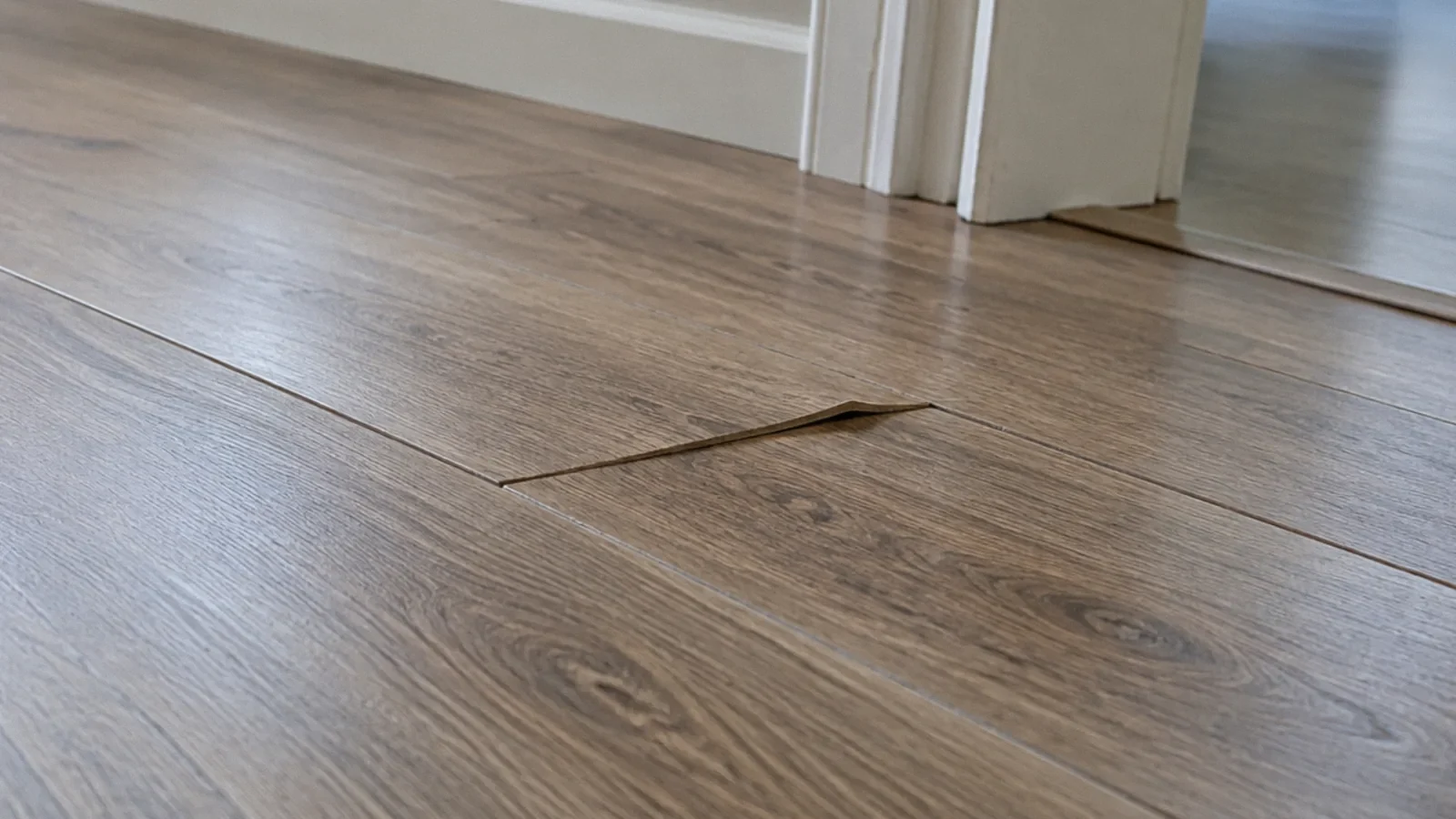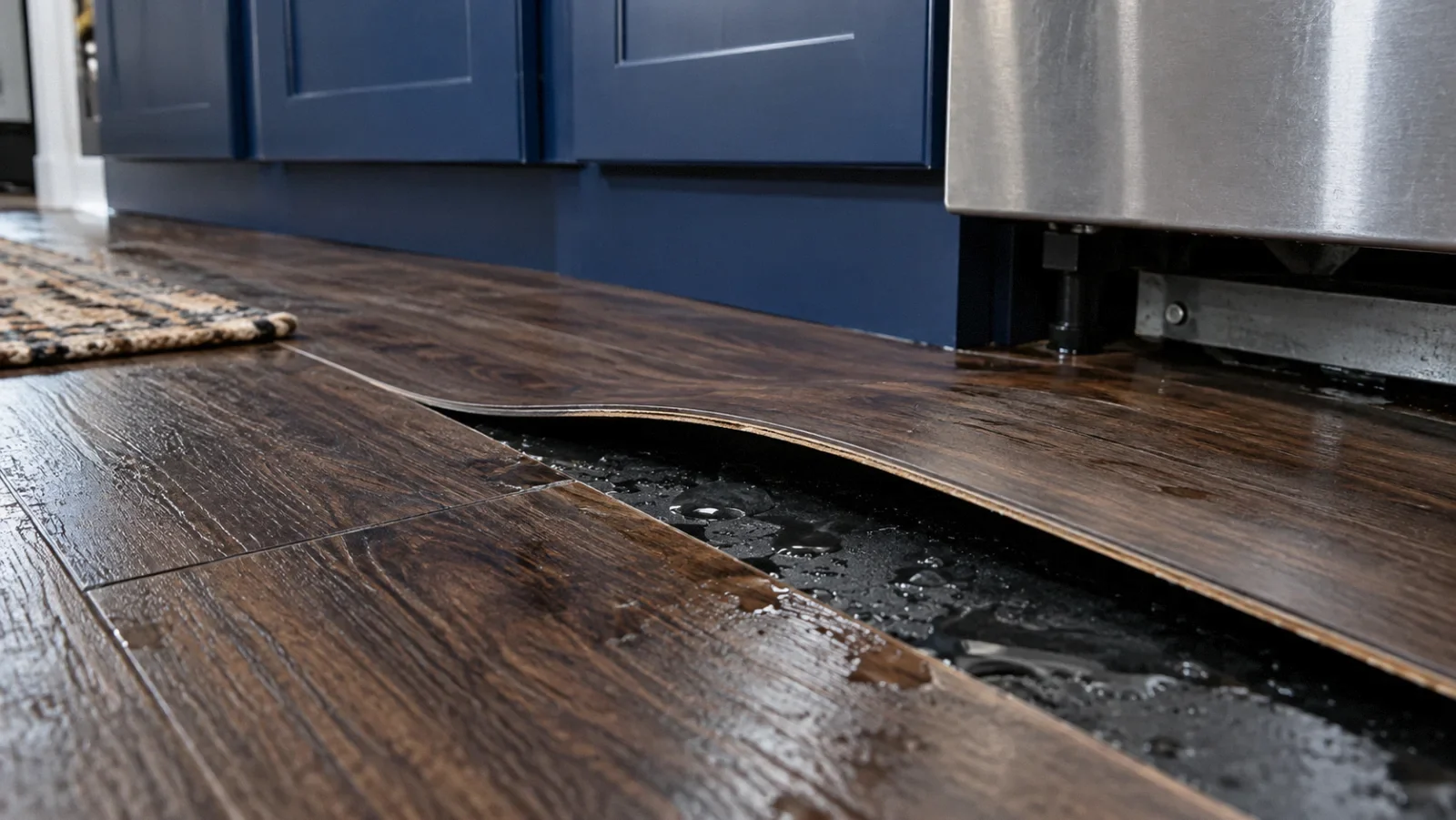
Vinyl planks can resist water damage while water remains underneath them. Check the pad, underlayment, subfloor, and adjacent wall bases before declaring the floor dry. “Waterproof” describes a product claim under defined conditions, not proof that the whole room is protected.
The surface and the assembly tell different stories
A vinyl plank may show little visible change after a spill or leak. That is useful for the plank itself, but it can also make the underlying water less obvious. Water can reach perimeter gaps, penetrations, joints, or edges around appliances and then move beneath the finish.
Identify whether the flooring is floating or adhered and whether it has an attached pad. Record the substrate and any separate underlayment. These layers determine where moisture could be retained and what inspection or removal would provide meaningful access.
Do not infer dry from the underside alone
In a wood-framed house, the subfloor may look ordinary from the basement even when moisture is concentrated at its upper face or between layers. On a slab, the exposed top of the vinyl may be the only visible surface. Neither view alone resolves the assembly’s condition.
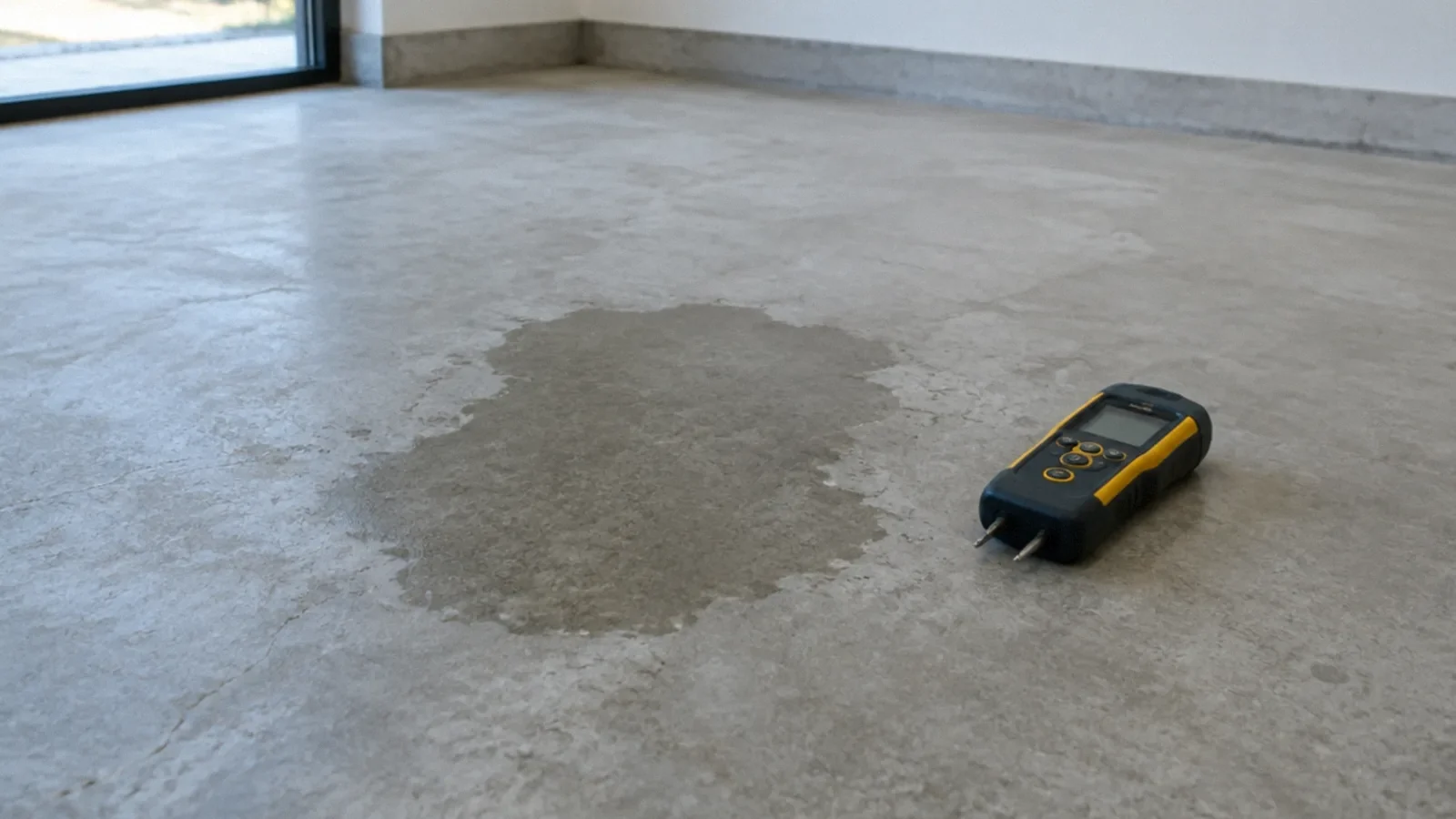
EPA’s hard-flooring guidance specifically includes checking and drying underflooring. Ask for targeted measurements and inspection based on the water route, not simply the absence of warped planks. If a screening meter responds through vinyl, have the result interpreted with attention to construction and instrument limitations.
Opening should answer a defined question
Removal can allow water extraction, cleaning, and verification, but the method must fit the installation. Floating boards may require an edge access route, and locking joints can be damaged during disassembly. Adhered flooring raises different questions about bond, adhesive, and substrate condition.
Before authorizing work, ask what the crew expects to find, how it will define the wet boundary, and how retained boards will be labeled and stored. Do not let “remove to inspect” silently become a promise that every board will be reusable. Reuse depends on actual condition and product requirements.
Contamination can decide what appearance cannot
Clean supply water and sewage or exterior floodwater do not have the same cleanup implications. A plank with an intact face may have contaminated backing or a pad that cannot be adequately cleaned. Access to all affected surfaces matters.
Discuss whether the underside, joints, pad, and substrate can be cleaned, not merely whether the vinyl surface can be wiped. Drying removes moisture; it does not demonstrate contamination removal. Keep the water-source assessment in the written scope so salvage decisions have an explicit basis.
An example of “waterproof” failing to answer the question
A washer discharge reaches the edge of a floating vinyl floor. The planks remain flat and the water visible on top is removed. If water entered beneath them, the relevant concern is now the pad or subfloor, not whether the vinyl face swelled. A top-only inspection can correctly describe undamaged planks while still missing a wet assembly.
The next step should identify where water could enter and whether targeted access confirms that path. If the underlying layer is wet, ask whether it can be extracted, cleaned, and dried with the current opening. If not, the plan needs more access or another justified method. Continuing to lower room humidity without reassessing access can consume time without resolving the bottleneck.
A concrete substrate creates a different final check from wood. It may require a specified slab test for the chosen installation, while a wood subfloor also needs a condition and flatness assessment. Keep those requirements attached to the product system rather than adopting a generic “floor moisture” threshold.
When reuse is plausible but still conditional
Reuse discussions should cover the plank underside, attached pad, locking profile, and ability to reconnect without gaps or damage. Labeling boards by location can help handling, but it does not establish their suitability. Ask who will inspect the removed material and who accepts responsibility for the reinstalled system.
If contamination cannot be adequately addressed in an attached layer, the intact face is not enough to justify retention. Document that distinction so replacement is grounded in the actual limitation rather than a broad claim that all wet vinyl must always be discarded.
Reinstall only over an accepted substrate
Before reinstallation, confirm that the underlying assembly meets the flooring system’s moisture and condition requirements. The installer should identify the test method and acceptance criteria for wood or concrete, rather than borrowing a number from an unrelated meter.
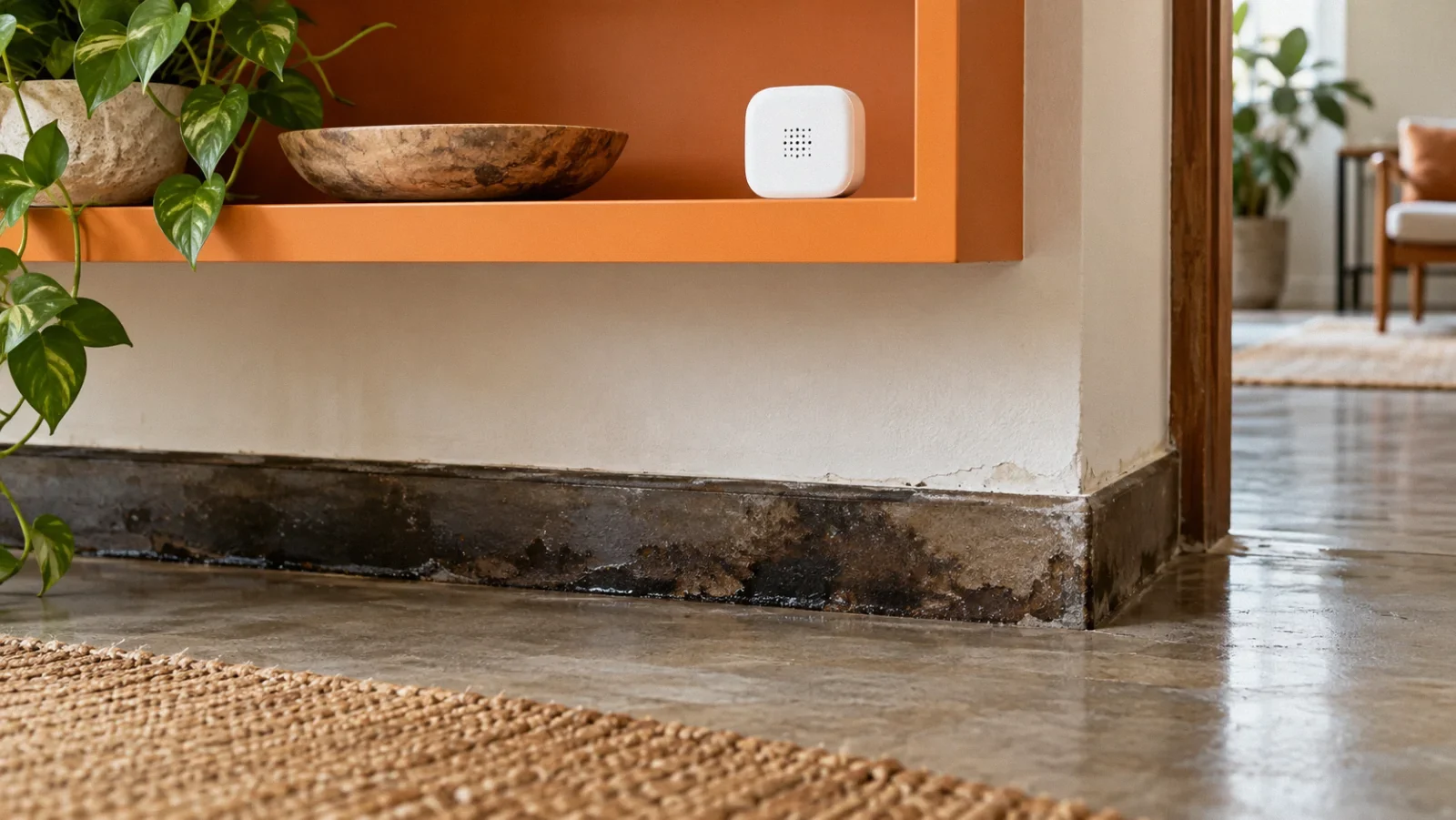
Address how the original water arrived. A repaired supply connection may be enough for the source, while recurring slab moisture or groundwater needs broader investigation. Do not add an unplanned impermeable layer as a universal fix: vapor-control choices belong to the whole assembly and local conditions.
Your next-step checklist
- Identify floating or adhered construction and every pad or underlayment layer.
- Document the water path at edges, appliances, penetrations, and adjoining walls.
- Ask how the wet boundary beneath the finish was established.
- Assess cleaning access and backing condition before deciding to reuse planks.
- Obtain substrate acceptance for the specific reinstallation system.
Related questions
Can a dehumidifier dry water trapped under vinyl?
It may support drying where moisture has an effective path to the air, but an intact low-permeance finish can limit that path. Access and progress measurements determine whether the method is sufficient.
Does an undamaged plank mean the pad is fine?
No. The backing and pad can have different moisture and contamination conditions. Inspect the layers directly where warranted.
Must the whole connected floor be replaced?
Not automatically. Extent, contamination, installation access, joint damage, product requirements, and matching can affect scope. Ask the contractor to separate those reasons in the proposal.
What should happen if more water appears during disassembly?
Record the location and revise the known wet boundary before continuing with reinstallation. Additional water can change extraction, cleaning, or access needs. The discovery should lead to a documented scope decision rather than being treated as an inconvenience to work around.
Sources & context
Public guidance supports the principles in this article. The practical questions and examples are editorial interpretation, not a site assessment or a coverage decision. State-specific rules apply only where identified.
- EPA: Table 1, Water Damage Cleanup and Mold Prevention (clean-water material guidance)official
- EPA: Moisture Control Guidance, Chapter 1 (moisture transport and whole-assembly control)official
Community questions behind this topic
These discussions helped identify reader concerns. They are anecdotal, not technical or legal authority.