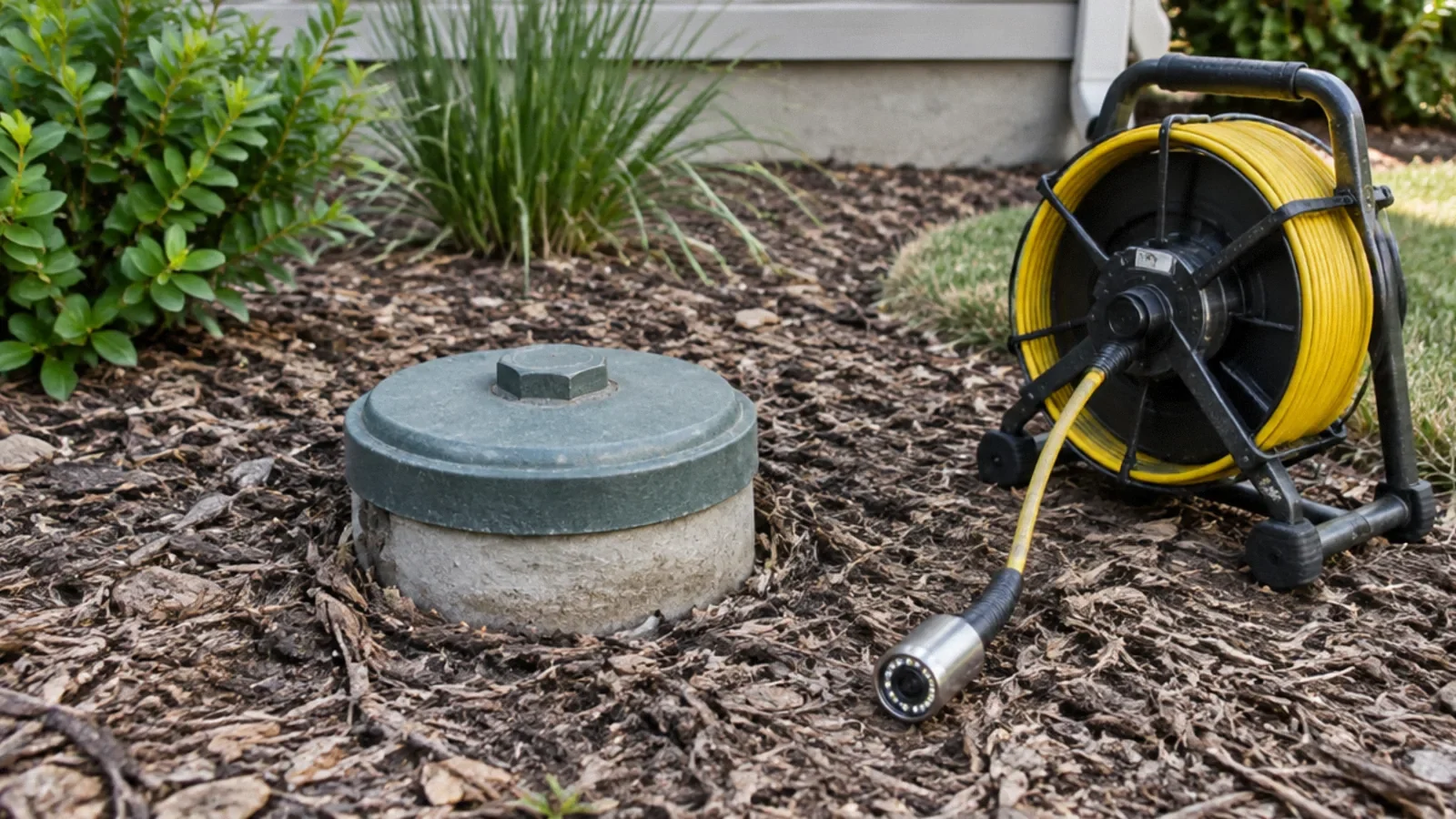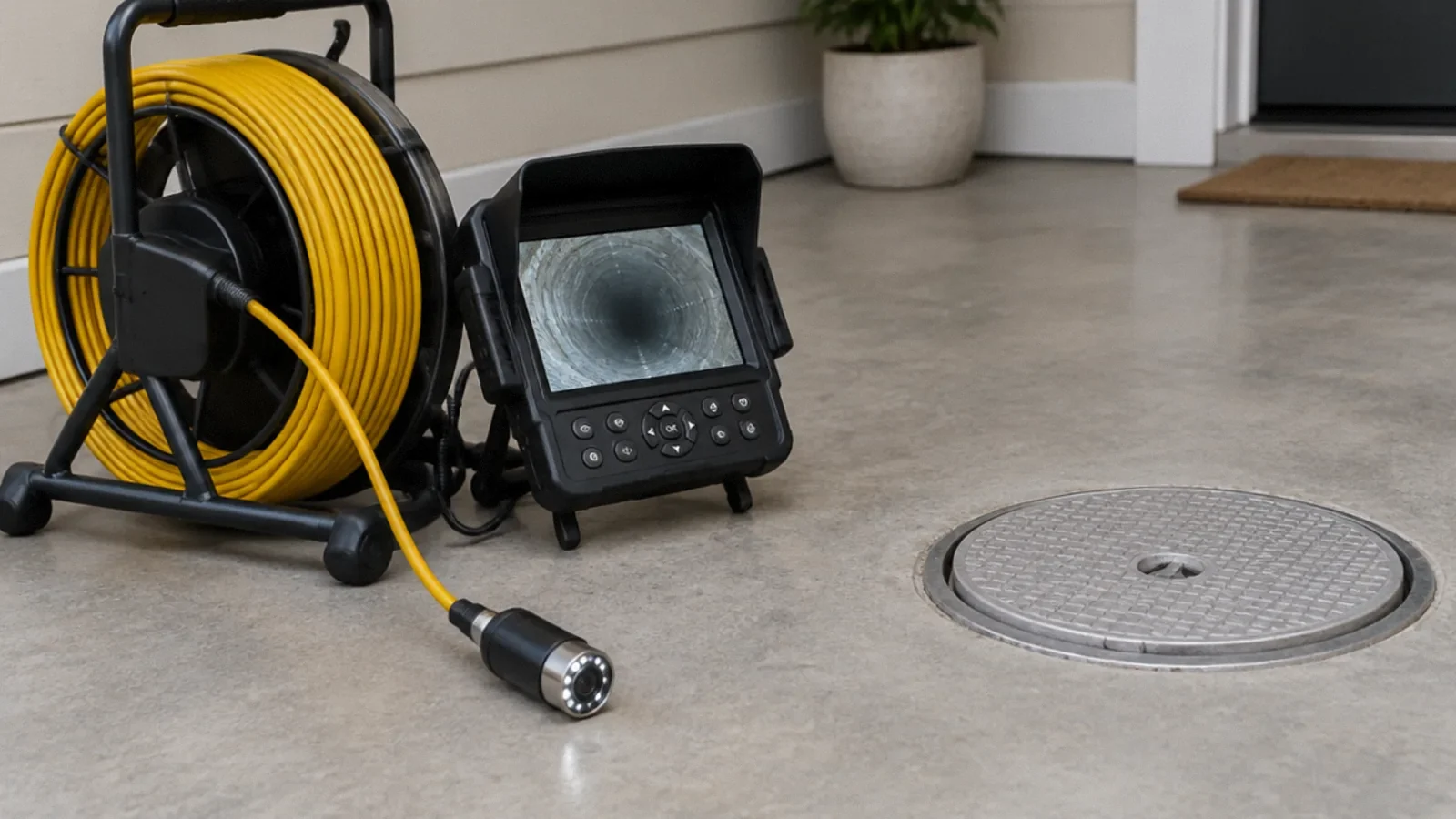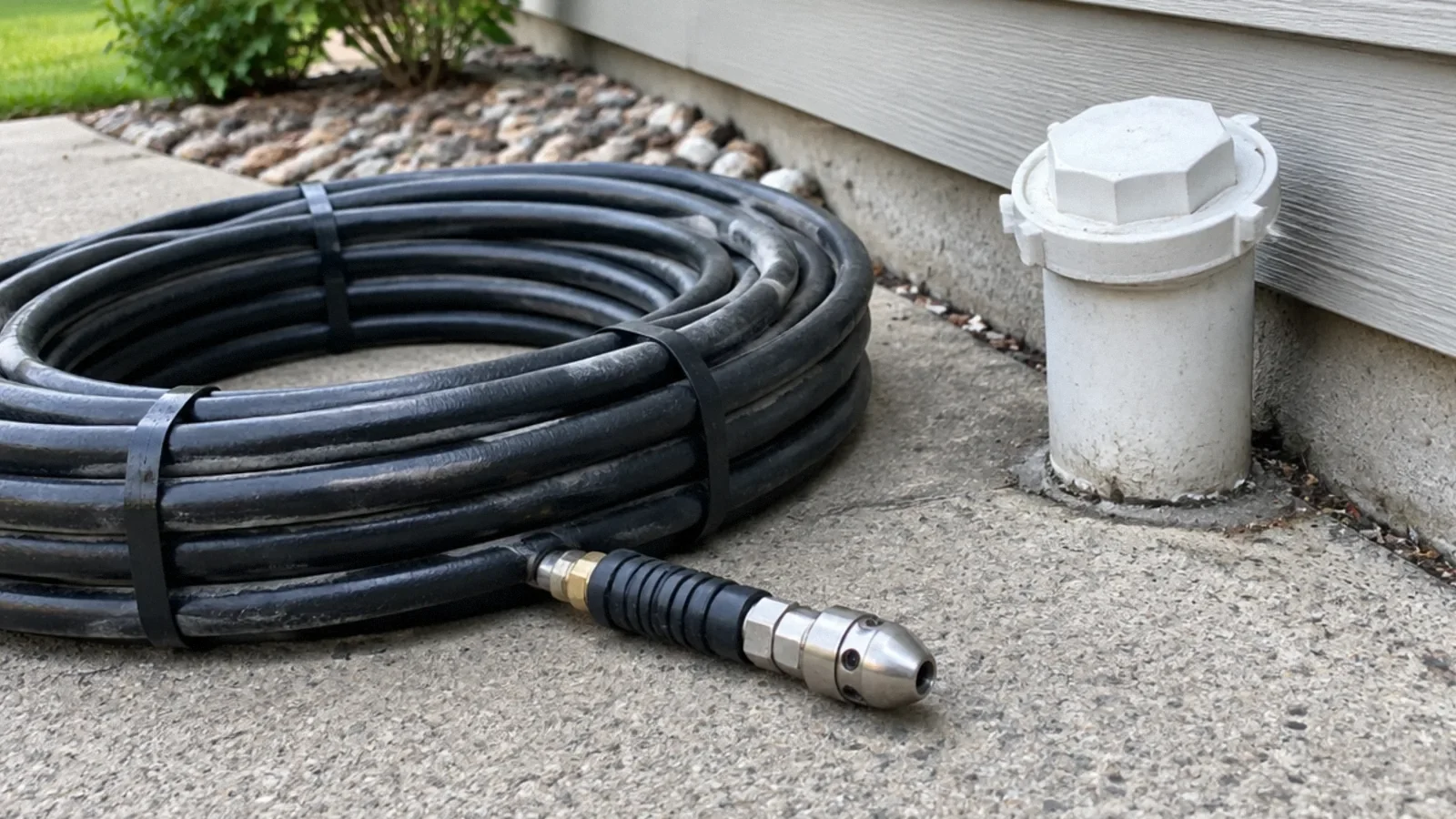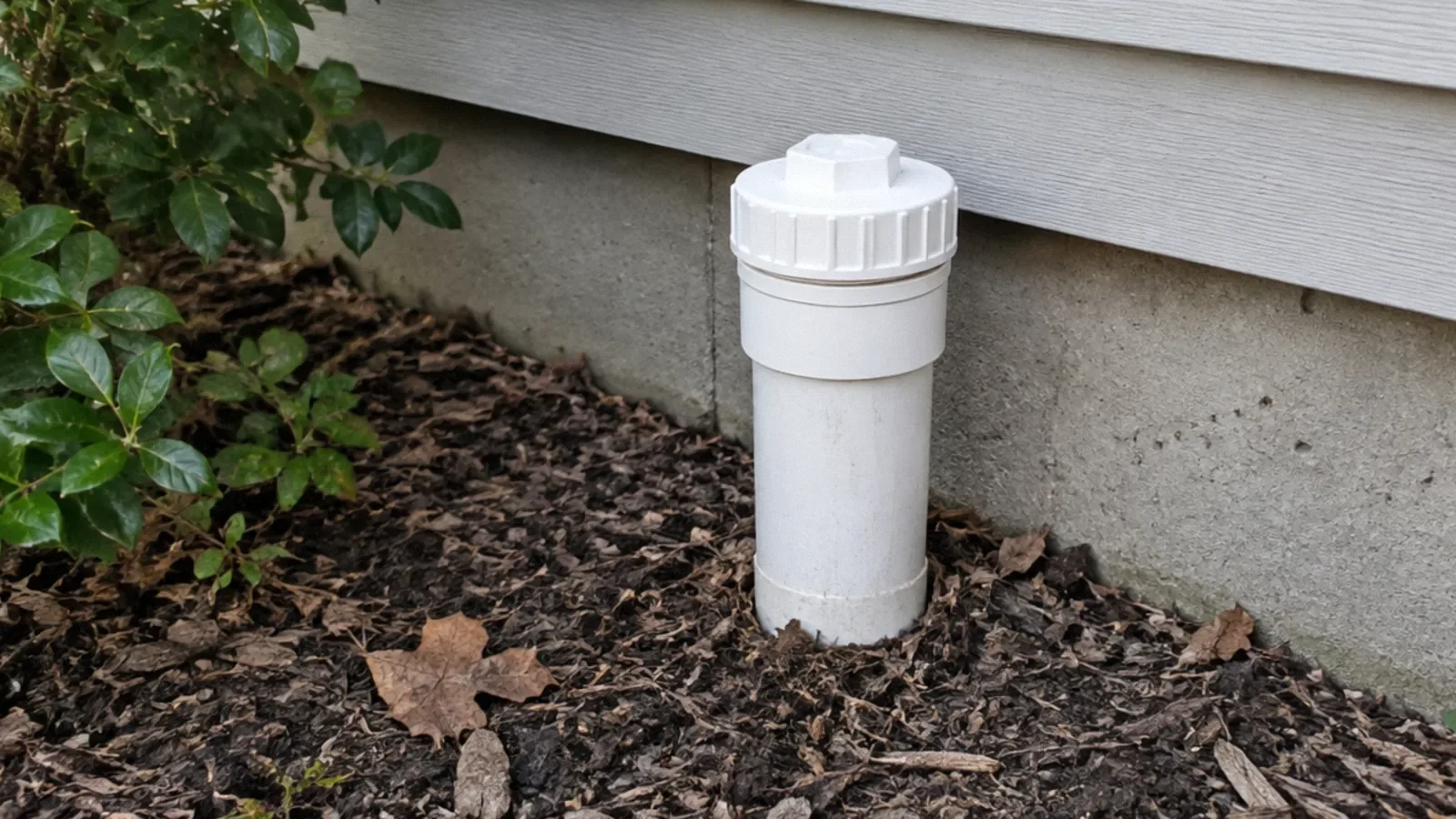
A sewer cleanout is a capped access point that lets a plumber reach a drain or sewer line for inspection and clearing. It may be outside near the building, in a yard, or inside; layouts vary. Do not open an unfamiliar or backed-up cleanout yourself, because wastewater may be present and the fitting may not be the access point you expect.
What a sewer cleanout does
A cleanout provides access to a plumbing line so a qualified person can inspect or clear it. The City of Minneapolis describes a sewer cleanout as a capped pipe giving access to a property’s sanitary sewer lateral. A cleanout is an access fitting, not necessarily a shutoff valve.
A building may have more than one cleanout serving different sections or directions. A cleanout connected to a sanitary sewer, a storm drain or a septic system may look similar from the outside but serve a different path. Identification requires knowledge of the actual plumbing.
What a cleanout may look like
A cleanout may have a circular threaded cap or plug, sometimes with a raised square, on a pipe at a wall, floor or the ground. Some are below a small cover. Materials and shapes vary, and a cap alone does not prove where the pipe leads.
Keep access visible and unobstructed, but do not remove a cap to confirm its purpose. A professional can inspect records and the actual system. Photographs of examples are useful for orientation; they are not a diagram or proof of the layout at a particular property.
Where to look around a house
Look outside near an exterior wall or along the likely path from the building toward the sewer. A small covered box may conceal access. Other homes have an interior cleanout, including in a basement, utility area or crawl space.
Local construction and site conditions differ. A cleanout may be hidden by vegetation, soil, flooring or an alteration, and not every older home has an obvious accessible fitting. Do not assume the street, city connection or neighboring house has the same configuration.
If you cannot find one
Review any plumbing drawings or inspection records and ask the owner or property manager whether the location is documented. The local wastewater authority may offer general guidance, while a plumber can evaluate the property and suggest a way to locate access.
Do not excavate around a suspected pipe without identifying buried utilities. In the United States, contact 811 before digging and follow the applicable local requirements. Utility markings do not replace careful work or necessarily identify every private line.
Why two caps may be present
Two nearby access fittings may serve different directions or sections of a line. Their appearance alone does not establish which way a tool would travel or whether both connect to the same pipe. A plumber can inspect the installation and explain the proposed access before work.
Do not try to force a stuck plug or use a tool inside an unidentified opening. A damaged fitting can leak, and a blockage may leave wastewater behind it. Preserve access for the contractor and tell them about recent repairs or known changes.
Water in or around a cleanout
A visible puddle around a cleanout can have several causes, including surface water, a damaged fitting or a backup. A full line or recurring overflow requires professional assessment; appearance at the cap cannot reliably identify the blockage or whether a municipal main is involved.
If sewage is backing up, stop using affected plumbing and keep people and pets away. Contact a plumber and, when appropriate, the local sewer authority. Do not open the cap, reach into the pipe or use electrical equipment near standing water. Contaminated water requires appropriate cleanup precautions.
Sanitary, storm and septic access
A sanitary line carries wastewater from fixtures; a storm line generally carries rainwater. A home served by a septic system has a different downstream destination from one connected to a public sanitary sewer. Access points can look alike, so verify which system is involved before any service.
Do not pour pool water, chemicals or other material into an unidentified cleanout. Check applicable local disposal rules and system capacity before any discharge. An access fitting is not a general disposal opening.
What to ask a plumber
Describe the affected fixtures, when the backup occurs, whether neighbors are affected and where you found a capped pipe. Ask the contractor how they will verify the line, control spills, protect the property and restore the cap after work. A camera inspection can help investigate a line but has its own access and visibility limitations.
Request a written scope and explanation of any proposed clearing or repair. Responsibility for a lateral and its connection varies by location and property; confirm boundaries with the local authority before assuming who must pay. A cleanout makes access possible but does not by itself establish a diagnosis.
Water cleanouts, outside sewers and the line itself
A “water cleanout” or “water clean out pipe” may mean a capped access fitting on a wastewater line, but the phrase alone does not identify its system. A sanitary sewer carries wastewater from household fixtures; a storm drain generally carries rainwater. Neither should be confused with a drinking-water supply pipe. Ask a plumber or the local utility to identify the actual connection.
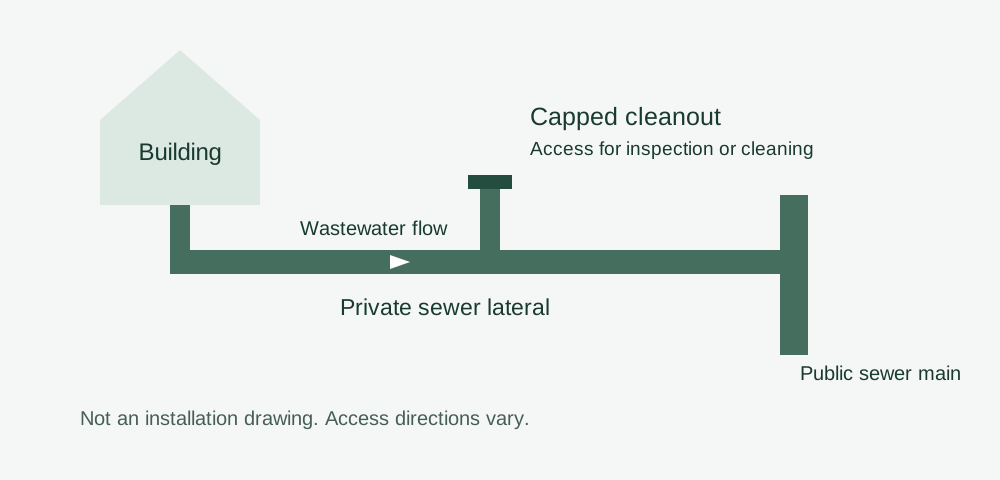
An outside sewer line is the buried pipe carrying wastewater away from the building; an outside cleanout is an access point on a line, not the line itself. The building drain collects branch drainage, the private lateral generally connects it to the public main, and the public main collects flow from multiple properties. Ownership and maintenance boundaries vary locally. For tracing the route, see our guide to locating the main sewer line.
Two-way or bullhorn cleanout
A bullhorn-style arrangement commonly has two access risers oriented in opposite directions, allowing a professional to work toward the building or toward the downstream sewer. The City of Campbell illustrates a two-way arrangement using back-to-back combination wye and one-eighth bends; actual fittings and permitted configurations vary. Two caps by themselves do not prove which system or direction they serve. A one-way cleanout generally provides access in one direction along a run, while a two-way arrangement is intended to allow access in both directions. A professional must identify the actual configuration.
A cleanout is an access fitting; “clean out a drain” may instead mean clearing a blockage. See our guide to safely unclogging a drain or our clogged sewer line guide for signs and response. Do not loosen or open a cap to investigate a blockage: backed-up wastewater may be under pressure and spill suddenly. Ask a qualified plumber to identify and safely access the line.
Branch, floor, wall and terminal cleanouts
A branch serving a bathroom or toilet may have its own access, but it need not be beside the toilet and its presence depends on the plumbing. A floor cleanout has a sealed cover over an access fitting; a floor drain usually has an opening or grate to receive water. A wall access panel can conceal a fitting, but a vent or other opening is not automatically a cleanout. Do not identify a system solely from a photograph.
A terminal cleanout provides access to a section at the end of a run; the permitted location and configuration depend on the applicable local code. Some systems have an access point near the base of a vertical stack or near the property line. A property-line cleanout does not by itself establish who maintains each segment. Check local records and ask the utility or a plumber. For code placement, see Where Are Plumbing Cleanouts Required; the rules applicable to a particular property depend on its jurisdiction and installation.
Septic line access is not a tank lid
A cleanout on a septic building sewer gives access to a pipe; the tank lid or riser provides access to the tank itself. A cleanout extended to grade is brought to ground level for access. Look at permit records and site plans or ask the septic service provider to identify the components without opening them.
Never open or enter a septic tank: dangerous gases and collapse hazards can be fatal. A damaged or missing cleanout cap should be reported for repair because the cap seals the access. Keep away from an overflowing or unidentified opening and do not remove a plug yourself.
Your next-step checklist
- Look for a capped access point near the building or along the likely sewer route.
- Keep the cap closed and accessible.
- Stop using affected plumbing during a backup.
- Contact 811 before any digging and verify private lines.
- Ask a plumber to identify the correct system and access point.
Related questions
What is a cleanout in plumbing?
It is an access fitting used to reach a pipe for inspection or clearing. Its exact location and connection depend on the installation.
Where is the main sewer cleanout?
It may be outside near a wall, in a yard or inside the building. Local records and a plumber can help if it is not obvious.
Why are there two sewer cleanouts?
They may provide access to different directions or pipe sections. A professional should confirm the actual arrangement.
Should I open the cap if sewage is backing up?
No. Wastewater may be behind the fitting. Stop using affected plumbing and contact a qualified plumber.
Where is my main sewer line?
The building drain leads toward a private lateral or septic system, but the route varies. A plumber can trace it using records and locating equipment.
What is a one-way cleanout?
Some cleanouts provide access in one direction along a drain line; a two-way arrangement may offer access in both directions. The actual configuration must be inspected, and opening a pressurized or backed-up line can release sewage.
What does a plumbing cleanout diagram show?
The diagram illustrates a capped access point connected to a sewer lateral. Actual configurations and access directions differ; it is not an installation drawing.
Sources & context
Public guidance supports the principles in this article. The practical questions and examples are editorial interpretation, not a site assessment or a coverage decision. State-specific rules apply only where identified.
- City of Minneapolis: Sewer cleanoutsmunicipal guidance
- Call 811: Know what is belowutility safety guidance
- East Bay Municipal Utility District: Private sewer lateralslocal utility guidance
- City of Portland: Sewer cleanout and lateralmunicipal sewer guidance
- City of Campbell: Sewer line cleanout handoutmunicipal plumbing guidance