Take the first safe steps
Explain where the water appeared, whether it is still entering and what access is available. Note when the leak or overflow began and whether the source has been repaired. The source and the affected material need an assessment at the property before the scope is settled.
Keep people and pets away from standing water, unstable ceilings and wet electrical equipment. Close a supply shutoff only if it can be reached without entering a hazardous area. Do not walk through water to operate a breaker. For an immediate threat to life, call 911 and follow directions from emergency personnel.
Note which room became wet first and whether fixtures were in use or rain preceded the problem. A stain may appear away from the source as water travels along a wall or beneath flooring. Record observations and take photographs only where it is safe; do not assume the source from the visible mark alone.
Sewer service and a backup
Union Sanitary District provides wastewater collection, treatment and disposal to Union City, Newark and Fremont. If wastewater enters through a fixture or floor drain, avoid adding flow through connected fixtures while the source is investigated. Keep occupants away from the affected area and arrange for the responsible parties to assess the line.
The district says property owners maintain the lateral from the building through the connection to the public main, including the section under a sidewalk or street. This boundary is important for arranging repairs, but a visible backup does not identify where the blockage is. Ask the plumber and district what has been checked before deciding on the next step.
Cleanup of a wet room and repair of the sewer are related but separate work. If the cause remains unresolved, a cleaned or rebuilt space can be exposed again. A written record of the fixture behavior, the investigation and any source repair helps the people coordinating treatment of the affected materials.
Permits for lateral work
Union Sanitary District requires a repair permit for lateral work, including work on private property. If excavation extends into a public right-of-way, its guidance identifies an additional encroachment permit for Union City. A sewer permit and permission to work in public space address different parts of the project.
Before excavation begins, ask the contractor to explain the location, proposed repair method, permits and inspection sequence. Work under a sidewalk or roadway can involve coordination beyond the building. The presence of water indoors does not prove excavation is required; the scope follows the condition of the line.
The district also has a demolition and sewer-capping permit process for Union City building demolitions. That is a distinct situation from ordinary water removal or replacement of a small area of damaged finish. Confirm the requirements with the city and district if the planned project actually includes demolition.
Drainage zones and the property
Alameda County Flood Control Zone 3A serves Union City and lists Old Alameda Creek and nine pump stations in its inventory. Zone 5 also serves part of Union City. These district zones extend beyond an individual address. Their inventories do not establish that every named facility lies on a property or that a particular building is in a mapped floodplain.
If outside water reaches a building, document its path and any high-water mark only when safe. Outdoor water may carry sediment or other contaminants. Avoid approaching moving water and damaged electrical equipment. After access is permitted, an appropriate professional can consider drainage, openings and the affected materials.
For a floodplain or insurance decision, check current official information for the exact address and ask the responsible agency about the project. A nearby channel, a storm history or a district maintenance activity cannot by itself determine a property’s flood designation or the cause of a single incident.
Temporary protective measures should never require someone to enter moving water or approach an electrical hazard. Follow an evacuation order or other official instruction when issued. After an event, a photo from a safe position and a note about when the water receded can help a professional understand the conditions. Such records do not replace a site inspection or an official floodplain determination.
Fixture replacement and building work
Union City’s Building Division handout identifies permitted water-heater and sewer-line replacements among repairs that do not trigger the specific SB 407 fixture-upgrade requirement described in that handout. This does not make those repairs permit-exempt or settle every other building requirement. Ask the city about the actual project and any applicable conditions.
A water-damage repair may combine plumbing, electrical, structural and finish work. Identify who will apply for permits and coordinate inspections before materials are covered. If a wall is opened and the scope changes, ask whether the plan or permit needs to be revised. Keep the approved documents and inspection record together.
The source repair and treatment of wet material are separate tasks. A replaced water heater may stop new water from entering while flooring or wall backing remains affected. Conversely, drying a room will not resolve a leak that continues behind a surface. The sequence should account for both conditions.
Assess materials after water exposure
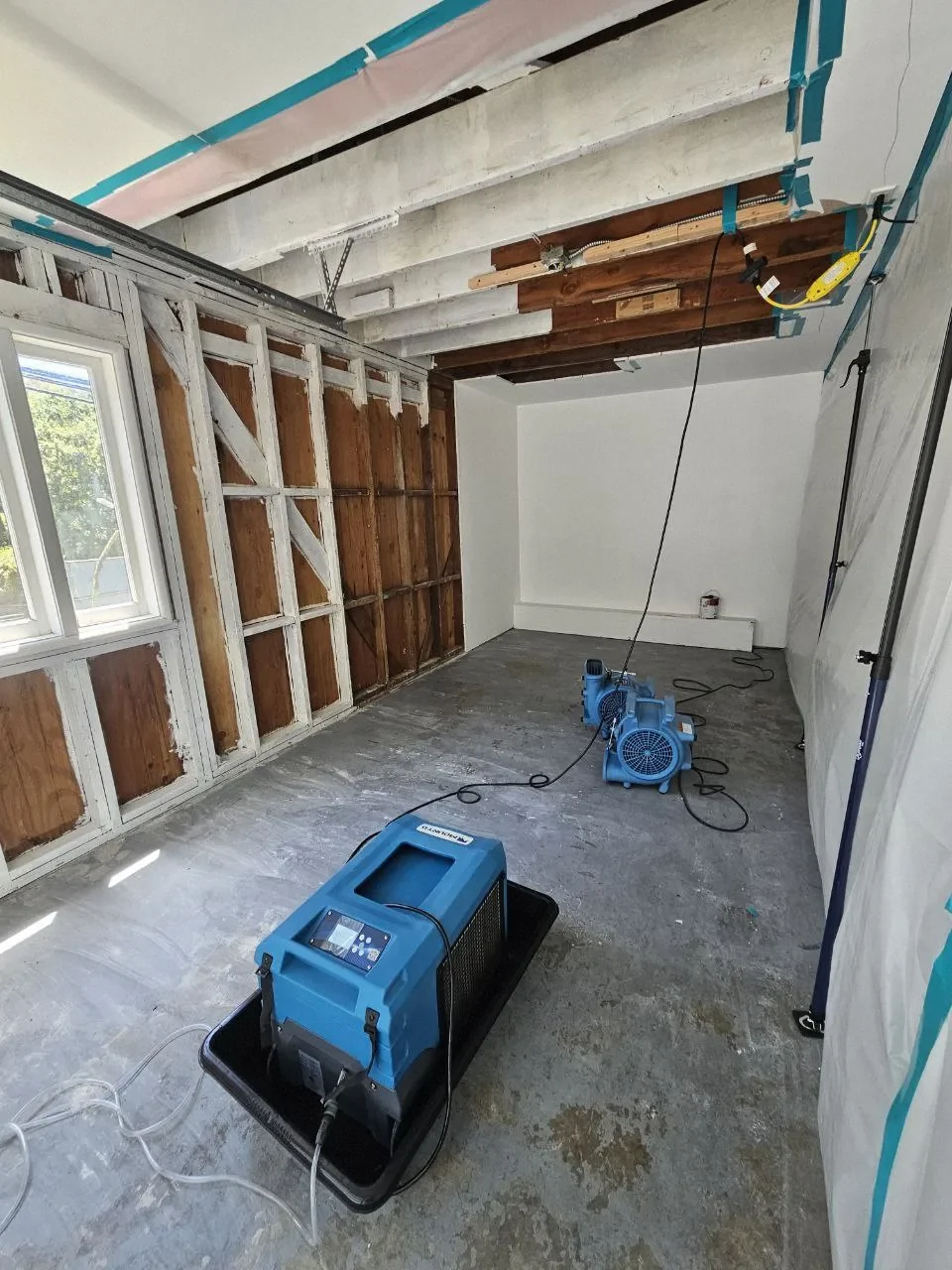
The visible edge of water does not necessarily show its full path. Flooring, cabinets, insulation and framing can retain moisture differently. An assessment should identify which layers can be inspected and where further access may be needed. If part of an assembly cannot be examined safely, record the limitation rather than assuming it is unaffected.
Ask for a plan that distinguishes water removal, treatment, drying and reconstruction. The method depends on the material, duration of exposure and source of water. A contaminated backup and a small supply leak are not interchangeable. Protect unaffected rooms and belongings while the affected space is evaluated.
Before replacing finishes, discuss how the remaining material has been checked and whether required inspections have occurred. If further damage is discovered during work, request an explanation of the finding and the proposed change. A documented scope makes it easier for the owner, insurer and contractors to coordinate.
A floor assembly can include a finished surface, underlayment and structural support. Each layer can hold water differently. Ask what can be checked without removal, where opening may be needed and how the remaining materials will be evaluated before new finishes are installed. The proposed method should account for the type of water and the condition found. An inaccessible space should be listed as a limitation rather than described as unaffected simply because it was not examined.
A discussion of contents should also distinguish what can be assessed immediately from belongings that remain in a restricted room. Ask the owner or official responsible for access before retrieving anything. Keep an inventory of items examined and preserve instructions from the insurer about documentation and disposal.
Local areas and different buildings
Union City’s General Plan map identifies the Decoto neighborhood and Historic Alvarado District as special planning areas. These names describe places; they do not establish the flood status, pipe material or condition of a particular property. Check the actual address and agency boundaries before applying a local rule.
A shared building may have pipes, utility controls or access routes serving more than one unit. Identify the owner or manager who can coordinate entry and any interruption of shared service. Record the rooms affected and the first observations without assuming which unit contains the source.
If you rent, tell the owner or manager promptly and keep a copy of the request. Access, habitability, temporary accommodation and insurance are separate questions. Ask the appropriate city service or housing adviser how the applicable rules affect the specific tenancy.
The practical details can differ even among buildings on the same block. Renovations, changes in use and earlier repairs may have altered individual systems. Ask for an explanation of the evidence used to select a repair method and whether there are areas that could not yet be inspected. A specific finding is more useful than a broad assumption based on the appearance or age of the building.
Document and coordinate
An insurer may ask for photographs, estimates, receipts or an inventory of damaged contents. Ask what is needed and whether an inspection should occur before items are discarded. Coverage depends on the policy and circumstances. Do not enter a dangerous space merely to collect evidence.
Before a visit, identify a safe contact for the property, any access restrictions and any source work already performed. If a utility or inspector has provided findings, share them with the team evaluating the room. If the cause is still unknown, state that clearly and keep the investigation separate from assumptions about the building.
Call Water Damage Guard at (650) 550-0619, 24/7, to discuss water damage in Union City. A useful written scope describes who handles the source, how the affected material will be evaluated and what happens if additional damage is found. Keep the handoff between repair and reconstruction clear.
Where more than one contractor is involved, identify the person who will receive updates and keep the records. Source repair, building inspection and restoration can happen at different times. If an approved repair must remain open for inspection, agree on how the space will be protected and when the next review will be requested. If new information changes the work, record the reason and ask each responsible party how the revised sequence affects its task.
Common questions
Who provides sanitary sewer service in Union City?
Union Sanitary District provides wastewater collection, treatment and disposal to Union City, Newark and Fremont.
Who maintains the private sewer lateral?
The district says the property owner maintains the lateral through its connection to the public main, including the portion beneath a sidewalk or street.
Does lateral excavation in public space need another permit?
Union Sanitary District identifies an encroachment permit in addition to the lateral repair permit when excavation enters the public right-of-way.
Do district drainage zones determine my flood status?
No. Zones 3A and 5 serve portions of the area, but current official information for the address is needed for a property-specific designation.
Does the fixture handout exempt water-heater replacement from a permit?
No. The Union City handout describes certain repairs that do not trigger the specified fixture-upgrade requirement; it does not waive applicable permits.
Sources
- Union Sanitary District Tri-City information Checked
- Union Sanitary District sewer repair guidance Checked
- Union Sanitary District demolition permits Checked
- Alameda County Flood Control Zone 3A Checked
- Alameda County Flood Control Zone 5 Checked
- Union City water-conserving fixture handout Checked
- Union City General Plan special areas Checked