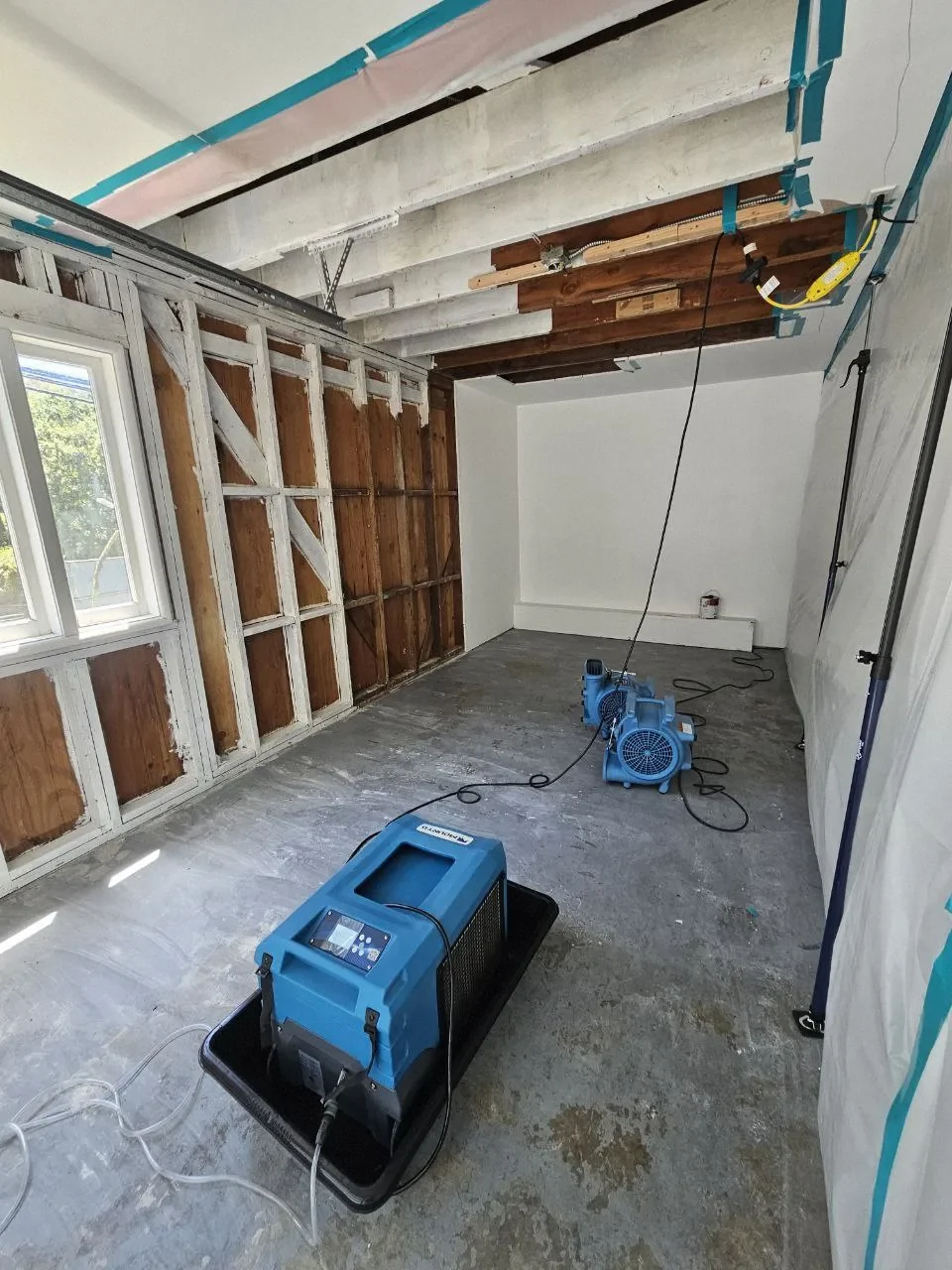
Start with safety and stop the source
If water is entering a room, move people and pets away from it. Close a fixture shutoff only if it can be reached safely. Do not enter standing water to reach an electrical panel or touch a wet appliance. If the ceiling is sagging, stay out from under it; water and damaged material may fall. Call 911 for an immediate threat to life.
Water Damage Guard provides restoration in Hillsborough from its San Carlos base. Call (650) 550-0619 at any hour. Describe where the water appeared, whether the source is still running, which rooms are involved and any access restriction. If a pipe, sewer or public system may be involved, the responsible utility or a plumbing professional also needs to be contacted.
From a safe place, note the discovery time and take photographs if doing so will not delay an urgent response. A wet floor does not by itself reveal whether water came from a supply line, a drain, a roof or the ground outside. Those possibilities affect who investigates and how the affected materials are handled. Do not remove a wall merely to follow a stain before the source and any potential hazards have been considered.
Town water and sewer contacts
Hillsborough Public Works lists (650) 375-7444 for its water and sewer services and (650) 375-7470 after hours. The town's published Public Works hours are Monday through Thursday, 7:30 a.m. to 5 p.m., and Friday, 7:30 a.m. to 4 p.m. Tell the person receiving the report whether the issue is a suspected water-line break, a sewer backup, flooding or an unknown source.
If a drain has backed up, avoid using connected toilets, sinks and appliances while it is being investigated. Extra water can add to an overflow. If wastewater has entered the building, keep occupants away from the affected route and discuss both the plumbing response and cleanup. A cleared line does not automatically clean or dry a wall or floor; a cleaned room does not establish that the cause has been repaired.
For permit and inspection questions, the town lists the Building Division at (650) 375-7411. A utility call, a plumbing repair, a restoration assessment and a building inspection answer different questions. Keep their documents together so that the people doing subsequent work understand the source, the repair made and the spaces that were affected.
Private sewer laterals in Hillsborough
The town says that maintaining and repairing a private sewer lateral is the property owner's responsibility. A lateral connects a building to the public sewer. When a backup occurs, the visible point of entry does not establish whether the blockage is in the lateral, the building plumbing or a public line. Contact Public Works and arrange an appropriate investigation rather than assigning responsibility from the location of a puddle.
Hillsborough's FAQ says a home's sewer lateral must be inspected when the home is sold and repaired or replaced when necessary. An owner preparing a sale should ask the town about the property, the inspection procedure and any conditions or exceptions that apply. Keep inspection reports, invoices and permit records; they describe different parts of the transaction and the work.
The town offers free pop-up covers for residential sewer cleanouts that allow sewage to escape outside in the event of a lateral blockage. Ask Public Works whether a cover is appropriate for the cleanout and how it should be installed and maintained. An exterior release can reduce the chance that a backup enters through an indoor fixture, but wastewater outside is still a health concern that needs a proper response.
Why wet-weather sewer capacity matters
Hillsborough describes a collection system with more than 90 miles of pipe. It is a satellite system: the wastewater is sent to treatment plants operated by Burlingame and San Mateo. A property owner deals with the town and the relevant plumbing professional for a local problem; the treatment plant operator is not necessarily the first contact for a backup at the house.
The town reports that wet weather contributed to more than 89 public sewer overflows from December 2004 through January 2009. It says the Regional Water Quality Control Board issued a cease-and-desist order in late 2009 requiring a comprehensive plan to eliminate public sewer system overflows. These are historical facts about the town's system, not an assertion that a particular street or home flooded or that an overflow is happening now.
For an owner, the practical distinction is between stopping a current discharge, determining which pipe needs work and documenting any building damage. If an overflow appears outside, keep away and report its location. Do not assume that wastewater outdoors has no effect on the surrounding area. The town’s historical program describes a system-wide response; it does not determine the condition of one home or its lateral.
Hillside drainage and water entry
Water appearing at the base of a wall during rain may reflect surface runoff, drainage beside the building or another path. The first observation is not a diagnosis. Record when water appeared, where it entered and whether it continued after rainfall stopped. A drainage professional can examine the slope, retaining structures, downspouts and discharge path without assuming that every hillside property has the same condition.
Hillsborough's standard grading permit comments call for the geotechnical engineer of record to review grading, drainage and foundation plans before grading permit approval. These comments apply in the grading-permit process; they are not a statement that every cleanup requires a geotechnical report. If a permanent drainage or grading change is proposed, ask the town's Engineering Division which requirements apply to the project.
Temporary removal of water from an accessible area does not correct a recurring entry point. Ask who will evaluate the exterior conditions, whether proposed work changes the flow onto a neighboring property and what permits or inspections are needed. Do not enter a flooded crawl space to inspect equipment or drains. Where the ground or a retaining wall appears unstable, keep away and seek an appropriate assessment.
Permits, drying and the repair sequence
Hillsborough processes permit applications through its electronic eTRAKiT portal. The Building Division can explain whether proposed reconstruction, plumbing or electrical work requires a permit and which inspections apply. Do not assume that every drying activity is permitted work, or that all rebuilding is exempt. Describe what will actually be removed, altered or replaced.
Coordinate the work in a sensible order. Stop the source and identify affected areas, arrange any separate plumbing or drainage repair, then clean and dry materials as appropriate before replacing finishes. If a permit requires inspection of work that will be concealed, coordinate that inspection before a wall or floor is closed. Ask the people responsible for the project how they will record the condition of remaining material.
A stained plaster wall, swollen wood trim and wet carpet padding need not have the same outcome. The source, time wet, contamination and condition of the material all matter. Ask what can be assessed, what will be removed and why. If older coatings or insulation may be disturbed, discuss appropriate lead or asbestos evaluation before demolition; the age of a building alone does not identify its materials.
People, property and records
If you rent or manage a shared property, report the water promptly to the person who can authorize access and repairs. In a building with shared systems, a leak may affect more than one space and require coordination with another occupant. Record what was observed and when notice was given. The building's agreements and the cause of the damage determine private responsibilities; a visible stain in one room does not resolve them.
Keep a safe inventory of affected belongings and photograph conditions when possible. Ask the insurer what records it needs if a claim is being made. Coverage and temporary living expense provisions depend on the actual policy and circumstances; a restoration provider cannot establish them. Keep receipts and copies of reports so that a later question about the sequence of work can be answered.
Before repairs finish, ask which area was assessed, how the source was addressed and what remains inaccessible. Request the relevant town, plumbing and restoration records. Water Damage Guard can discuss the restoration scope; Public Works, the Building Division, a plumber and an insurer each have a separate role.
When a repair involves a shared access route, discuss practical arrangements before equipment or materials are moved. Ask where residents can safely enter, which rooms will be unavailable, and who will coordinate access for inspections. If a water source has not been established, keep that uncertainty in the written record. The right next step may be a plumber’s investigation, a review of exterior drainage, or an inspection of a concealed assembly rather than immediate replacement of every surface that shows a stain.
- Water damage in a rental
- Temporary housing and expenses
- Burlingame
- San Mateo
- Wildfire smoke in San Mateo County homes: cleanup after a smoke event
- Water damage after fire
- Wildfire smoke damage in house
- Clogged sewer line signs and response
- French drain basement water explained
- Wildfire preparedness california
- Hillsborough defensible space
Common questions
Who should I call for water or sewer trouble in Hillsborough?
The town lists Public Works at (650) 375-7444 and its after-hours number as (650) 375-7470. For restoration, call Water Damage Guard at (650) 550-0619.
Who maintains a private sewer lateral?
The town says maintenance and repair of sewer laterals are the property owner’s responsibility. The cause and location of a particular backup still need investigation.
Is a lateral inspection needed when a home is sold?
The town FAQ says the lateral must be inspected at sale and repaired or replaced if necessary. Ask the town about the property and applicable conditions.
Does the town offer a sewer cleanout cover?
The town says it provides free pop-up residential cleanout covers designed to let sewage escape outside during a lateral blockage. Ask Public Works about the actual cleanout.
Does every water-damage repair require a permit?
Requirements depend on the work. Describe the planned repair to the Building Division; Hillsborough processes permit applications through its online portal.
Does a wet hillside wall always need a grading project?
No. The water path must be investigated first. If grading or drainage work is proposed, ask the town which project-specific requirements apply.
Sources
- Town of Hillsborough Checked
- Town of Hillsborough Checked
- Town of Hillsborough Checked
- Town of Hillsborough Checked
- Town of Hillsborough Checked