Responding when water is still entering
Keep people and pets away from standing water, wet electrical equipment and any ceiling or floor that appears unstable. Do not walk across water to reach a breaker or handle a wet appliance. If the condition presents an immediate threat, leave and call 911. A readily accessible fixture shutoff may stop a leak, but only use it if you can reach it safely.
Mountain View’s 2024 water quality report lists Public Services at 650-903-6329 for emergencies at any hour. Cal Water identifies portions of Mountain View within its Los Altos Suburban District and lists 650-917-0152 as its main and after-hours number. Check the provider for the address rather than assuming the city supplies every property. A water bill or the utility can help identify the correct contact.
When speaking with the responsible party, say whether the water is still flowing and which rooms are affected. A description of the source is helpful, but a suspected pipe or appliance is not a final diagnosis. Take photographs from a safe location and note when the problem began. If you rent or share a building, notify the owner or manager so that access to shared systems can be coordinated.
Finding the path water followed
A stain can be a useful clue without identifying the actual entry point. Water from an upstairs fixture may appear at a ceiling seam; rain entering around a roof opening can travel along framing before becoming visible; a leak near a cabinet may extend beneath the floor. The assessment should consider the history of the problem, accessible materials and whether water is still present.
Explain any recent plumbing work, changes in water use, rain at the time of discovery and previous repairs. Moisture readings can help show where a closer look is needed, but they must be interpreted with the material and the surrounding conditions. If a cavity or neighboring room cannot be reached, record that limitation. The scope may change when a floor or wall is opened and concealed conditions become visible.
Avoid attributing a leak to a particular pipe material simply because a building is older. Mountain View’s 2024 water quality report says its city-system inventory identified no lead service lines, while it also distinguishes private plumbing components. That system inventory does not identify what is installed inside an individual home. The actual line and its condition require inspection.
If a leak is beneath a slab, identifying and stopping its source can guide how wet flooring and adjoining materials are assessed before drying.
Neighborhood history and the individual building
A city-hosted final draft historic context study describes the Monta Loma Eichler tract as built approximately from 1954 to 1957, ultimately comprising around 200 homes. This is historical context for a defined tract, not evidence that every home has a particular foundation, pipe material or present damage. Renovations and building conditions vary even among nearby properties.
The city’s neighborhood map uses names including Monta Loma, Old Mountain View, Cuesta Park, Rex Manor and Sylvan Park. These names help identify where service is requested; they do not establish parcel boundaries or predict a water problem. Describe the actual building, the affected room and the observed water path when requesting an assessment.
Older plans, past invoices or a previous owner’s repair record can help a contractor understand what may be behind a wall. Treat them as starting information rather than a substitute for the site inspection. When a concealed line is involved, the repair trade can explain whether further access or a different diagnostic method is needed.
Rain, creek projects and an address-specific assessment
Valley Water reports that the Permanente Creek flood protection project is complete. The regional project is useful context when considering stormwater, but it does not establish a particular parcel’s hazard or prove that water in a room came from the creek. Surface runoff, a roof opening and a plumbing failure require different corrections.
If rain coincided with the damage, record where water first appeared and whether it accumulated outside before entering. Photograph the path without entering an unsafe area. Keep debris away from safe, accessible entryways only when doing so does not expose you to moving water, electrical hazards or unstable ground. A qualified drainage professional can investigate a recurring exterior source.
Cleanup and source investigation should proceed as coordinated tasks. Extraction can address the water already inside, while an owner arranges the work needed to stop further entry. Replacing finishes before the source is corrected can hide a continuing problem. If sewage is suspected, limit access and tell the restoration team before moving affected belongings.
What restoration work can include
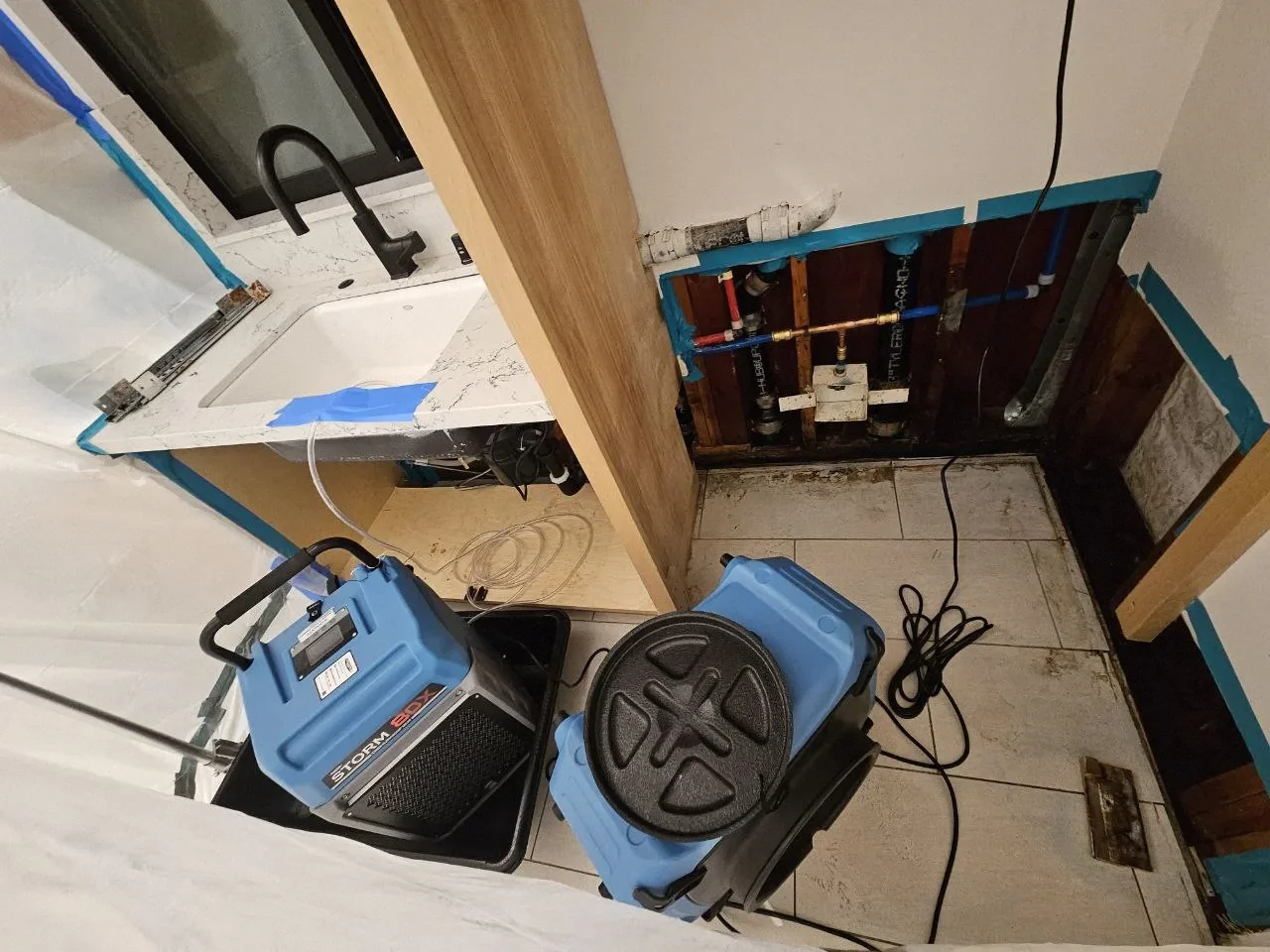
After the area is safe and the source has stopped, an assessment can identify standing water, wet finishes and materials that may have absorbed moisture. The work may involve extraction, protection or relocation of contents and drying. Some assemblies can be evaluated without major removal; others need an opening to reach concealed moisture or allow a trade to repair the source.
Discuss which rooms will remain accessible, where equipment can be placed and how belongings will be handled. An occupied apartment, a detached house and a commercial space have different practical needs. A clear work area and an agreed route for moving materials can reduce disruption and help the people involved understand where work is occurring.
Measurements taken over time can help guide drying decisions. They do not guarantee that a hidden area is dry when it has not been examined. If an access limitation remains, the owner should understand it before authorizing finish repairs. A work plan should explain what is known, what could change the scope and how unexpected findings will be communicated.
Renters, owners and shared spaces
The Census Bureau’s 2020–2024 American Community Survey estimate reports that 38.6% of occupied housing units in Mountain View were owner-occupied. That citywide estimate describes tenure, not the condition of any unit. It also means a response plan often needs to identify who occupies the space and who can authorize work or provide access to a shared system.
A renter should report the leak or water entry to the owner or manager promptly and retain a dated record of the report. In a shared building, moisture can cross a ceiling, wall or floor and access may be needed in another unit. Coordinate with the person responsible for common areas before opening an assembly or arranging repairs to a building system.
If a household has to relocate temporarily, discuss the practical sequence with the owner, manager and relevant housing resources. Do not assume that the presence of a stain automatically establishes a particular entitlement or repair deadline. The applicable rules depend on the tenancy, the condition and the reason for the work.
Repair permits and emergency work
Mountain View’s local building ordinance allows emergency construction at any hour or day. When an emergency happens outside business hours, the contractor, owner or applicant must report it to police and the Building Division by the next business day. This rule concerns emergency construction; it does not turn every inconvenient repair into an emergency or remove the need to check permits.
A 2025 city document described same-day building permits without construction plans for qualifying water-heater replacements at single-family homes and duplexes. Treat this as the city’s documented 2025 process and confirm current eligibility before relying on it. A replacement in a different location or work involving additional trades can have a different scope.
Give the Building Division an accurate description of the proposed plumbing, wall, electrical or equipment work and ask which permits and inspections apply. The person who obtains the permit should coordinate the inspection before work is concealed. If further damage is discovered, discuss how to update the scope. Drying a wall, replacing a pipe and rebuilding a structural assembly are separate decisions.
Moisture that returns
When a stain reappears, record whether it follows rain, fixture use, irrigation or another event. The timing can help narrow the investigation, but it does not prove a cause. A persistent odor or visible discoloration also warrants attention to the moisture source. Covering the surface before the source is understood can make a recurring problem harder to diagnose.
A restoration plan should explain which materials are affected and why they are proposed for cleaning, drying or removal. Some items may need separate handling, and an owner should be able to understand what is being discarded. If a shared wall or common pipe is involved, coordinate with the owner or manager so that work in one room does not leave the source active in another.
After the repair, keep the invoice and a short record of the affected area. If the same symptom returns, those records can help the next person understand what was opened and repaired. A new issue may have a different cause, so evaluate the present conditions rather than assuming an earlier repair failed.
Calling Water Damage Guard
Water Damage Guard is based in San Carlos and serves Mountain View. Call (650) 550-0619, 24/7, to discuss water damage restoration. Tell us whether the source is controlled, what type of water may be involved and whether any rooms or utilities are unsafe. The scope of extraction, cleaning and drying depends on the property assessment.
For a claim, ask the insurer about documentation and next steps. Keep photographs, invoices and a record of communications. Coverage and authorization are decided by the policy and the parties involved. Restoration, source repair and reconstruction may be performed by different trades, so confirm the responsibilities and timing before work is covered.
- Sewage cleanup in Mountain View
- Flood cleanup in Mountain View
- Fire damage restoration in Mountain View
- Rental water leak responsibilities
- Condo upstairs leak hoa insurance
- Additional living expenses water damage
- Sewer camera inspection
- Slab leak repair options
- Flood damage restoration process
- Neighbor water damage evidence
- Hoa responsibility for foundation cracks
- Mountain View sewer lateral rules: who pays, when an inspection is required
Common questions
Who answers Mountain View water emergencies?
The city’s 2024 water quality report lists Public Services at 650-903-6329 for emergencies at any hour. Confirm the utility serving the address.
Does Cal Water serve every Mountain View address?
Cal Water identifies portions of Mountain View in its Los Altos Suburban District. Check the water provider for the property.
Does a Permanente Creek project guarantee a property cannot flood?
No. Valley Water reports its project is complete, but an individual address and the actual route of water need separate evaluation.
Does the city inventory identify the pipe inside my home?
No. The 2024 city-system service-line inventory does not establish the material of private plumbing components.
Can emergency construction occur outside normal hours?
Mountain View’s ordinance allows emergency construction at any hour and specifies next-business-day notification when an emergency occurs outside business hours.
What is known about the Monta Loma Eichler tract?
A city-hosted final draft study dates it approximately to 1954–1957 and describes about 200 homes. It does not establish the current condition of an individual house.
Sources
- Mountain View 2024 water quality report Checked
- Cal Water Los Altos Suburban District Checked
- Mountain View final-draft historic context study Checked
- Mountain View CERT neighborhood map Checked
- Valley Water Permanente Creek flood protection project Checked
- U.S. Census Bureau QuickFacts, Mountain View Checked
- Mountain View local building ordinance Checked
- Mountain View 2025 same-day permit guidance Checked