Water damage in Redwood City: protect people and stop the source
Keep away from standing water near electrical equipment. Do not walk through a flooded room to reach a panel or operate a wet appliance. If an accessible fixture valve can be closed without entering a dangerous area, it may stop the leak; otherwise leave and ask the utility or a qualified electrician or plumber for help. Call 911 for an immediate threat to life.
Notify the owner or building manager and record where and when the water appeared. Photograph from a safe position. A ceiling stain, wet baseboard or puddle is a useful observation, but it does not prove the source or show the full extent of moisture. A sagging ceiling, unstable floor or damaged utility needs professional attention before anyone works beneath or around it.
Water Damage Guard is based in San Carlos, CA 94070 and serves Redwood City. We accept calls 24/7 at (650) 550-0619. Tell us whether the water is still entering, whether sewage or electrical equipment may be involved and who can authorize access. The work needed can be determined only after the property is safe to assess.
Creeks and documented flooding
Redwood City’s safety element describes portions of the San Francisquito, Redwood, Cordilleras and Belmont watersheds within the city. It also records flooding in Friendly Acres and Centennial during the 1998 El Niño storms. These are documented historical conditions in named areas, not a prediction about every parcel or a statement that a particular house flooded.
OneShoreline reports permits for targeted sediment removal at locations on Cordilleras Creek and Atherton Channel. A permit or planned maintenance activity should not be described as proof that all work is complete or that an individual property is protected from every flood pathway. For a location-specific question, consult current official maps and agency information.
The county’s winter 2026–27 list identifies self-fill sandbags at 1400 Broadway and 2600 Middlefield Road, with a limit of 24 bags. Seasonal information can change and supplies may run out, so check before going. Sandbags address only some routes of water entry; they do not make it safe to enter floodwater or correct a failed indoor pipe.
- Redwood City’s public safety element describes portions of the San Francisquito, Redwood, Cordilleras and Belmont watersheds within the city.
- OneShoreline reports permits for targeted sediment removal at locations on Cordilleras Creek and Atherton Channel.
- The county’s winter 2026–27 list identifies self-fill sandbags at 1400 Broadway and 2600 Middlefield Road, with a 24-bag limit.
- Redwood City creek flooding
- Flood cleanup in Redwood City
- King tides in San Mateo County
- San Mateo County flood zone maps
- Prepare for the rainy season
- San Mateo County sandbags
- Atmospheric river damage
Trace moisture beyond the visible edge
A water source may be a failed fixture, a leak from a neighboring space, a roof opening or water entering from outside. Each calls for a different source repair. During an assessment, identify what is known, what remains inaccessible and whether water continues to enter. Correcting the source and drying affected materials should be coordinated so that the same area is not repeatedly wetted.
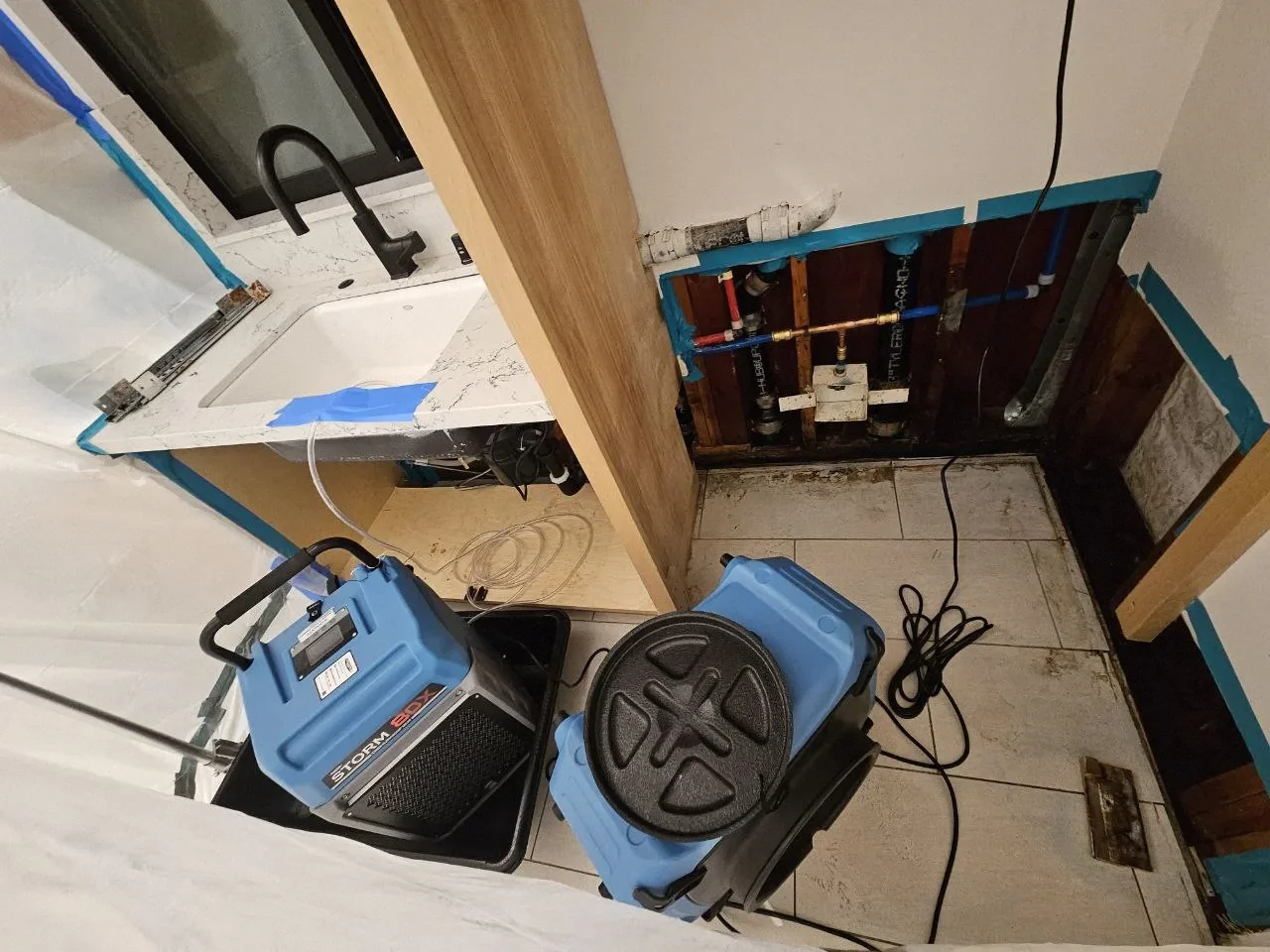
Water can move under flooring and behind baseboards, cabinets or wall finishes. Extraction addresses standing water; drying deals with moisture that remains in materials and air. A plan may include moving contents, using equipment suited to the site and monitoring progress. Placement must account for electrical safety and the water source. The condition of the materials, rather than a fixed timetable, determines the work.
Ask why a surface or item is proposed for cleaning, removal or retention. Contaminated water can require a different response from a clean supply leak, and porous materials can be harder to clean than hard surfaces. Record what was inspected and what could not be reached. A new finish should not be installed over an active source or an unresolved wet assembly.
Documenting a claim and protecting belongings
Make a room-by-room list of affected contents when the property can be entered safely. Note items that were underwater, those exposed to dampness and any essential papers or equipment that need priority attention. A photograph can preserve the initial condition, but do not risk injury to obtain one. Mark an item as inaccessible if it is in a space officials have not cleared.
Ask the insurer what information it needs and whether it wants to inspect particular belongings before disposal. Keep receipts, notices and the names of people contacted. If damaged items must be moved, agree on a dry storage area and a route that does not spread residue through unaffected rooms. Different materials have different cleaning possibilities; avoid promising that every item can be saved or assuming that every item must be discarded.
Where the source is a public sewer or street drain, report the problem to the responsible agency in addition to arranging private cleanup. Public investigation and work inside the building are separate actions. Record the agency report number and communicate any access or safety instructions to the owner and restoration team. If the source has not yet been identified, label it as suspected until the investigation establishes more.
Rental protections and repairs
Redwood City’s Ordinance 2554 provides a right of first refusal to reoccupy after a covered substantial-remodel termination. Coverage, exclusions and the facts of the project matter; not every water-damage repair or temporary move is a qualifying termination. Ask the city or a qualified adviser how the ordinance applies to the specific tenancy.
For covered no-fault terminations, the ordinance provides relocation assistance or a final-month rent waiver, with additional assistance for qualifying households. The ordinance contains detailed conditions, so a tenant and owner should review the current city information and seek appropriate advice for the particular situation. A restoration company does not decide whether a tenancy is covered.
Give notice of an active leak to the owner or manager in writing and retain a copy. Ask who will authorize access, correct the source and coordinate inspections. If the affected area cannot be occupied, document notices and expenses and ask the insurer or other responsible party what records are needed. Keep personal property records separate from the building repair scope.
- For covered no-fault terminations, the ordinance provides relocation assistance or a final-month rent waiver, with additional assistance for qualifying households.
- Redwood City tenant ordinance and repairs
- Rental leak responsibilities
- Temporary housing expenses
- California tenant rights
- Mold in a California rental
- California repair and deduct
Shared buildings and access
Census QuickFacts estimates that 48.6% of occupied housing units in Redwood City were owner occupied in 2020–2024. This citywide estimate does not establish the ownership or condition of a particular building. In a condominium or apartment, however, the visible damage and source may be in different units or common spaces, so access often needs coordination.
Ask the manager or association who controls the roof, service space, shared wall or neighboring unit that may need inspection. Do not enter another unit or open common construction without permission. The location of a stain does not by itself determine responsibility. Building documents, the cause of the leak and insurance terms may all need review by the appropriate parties.
Keep a timeline of notices, repair visits and any recurring wetting. Separate photographs of personal items from those of building materials. If an insurer is involved, ask what documentation and approval it needs before disposal where practical. Do not retrieve belongings from an unsafe space simply to complete an inventory.
The city’s neighborhood association map labels Friendly Acres, Centennial, Redwood Shores and Edgewood Park. Water Damage Guard serves Redwood City addresses across its neighborhoods; an association boundary or neighborhood name alone does not establish the water risk or condition of any home. Confirm the exact address and access arrangements when requesting an assessment.
Sewage, mold and fire
If water may contain sewage, keep people and pets away and avoid carrying affected items into clean rooms. Report a public-system problem to the responsible agency; a plumber may need to investigate a private line. Cleanup decisions depend on what the water contacted and whether materials can be adequately cleaned. Do not diagnose the location of a blockage by entering a hazardous area.
If a damp area shows suspected mold, correct the moisture source and avoid disturbing or painting over the material while it is assessed. EPA advises against running a heating or cooling system known or suspected to be contaminated because it can spread mold. Consult a health professional about personal health concerns rather than drawing conclusions from appearance.
After a fire, wait for the responsible authority to allow entry. Smoke, heat and suppression water can affect different areas and utilities may be unsafe. The restoration plan can address the observed conditions once access is safe. A mapped fire hazard does not determine the cause or extent of a particular structure fire.
Planning repair and documentation
Before work begins, list the affected rooms, the apparent source, any posted restrictions and the person who can authorize access. Ask for an explanation of the proposed sequence: source correction, assessment, cleaning or extraction, drying and monitoring, and repair where appropriate. If more damage is discovered, agree how the scope and approvals will be updated.
Changes to plumbing, electrical, structural or other building components may require permits or inspections. Ask the Redwood City Building Division about the actual scope before the work is concealed. Coordinate the source repair and required trades with the drying plan; a finished wall does not show the condition of work behind it.
Keep reports, photographs, correspondence and receipts together. Water Damage Guard serves Redwood City from its San Carlos base and accepts calls at (650) 550-0619 any time. Emergency services, utilities and public agencies retain their respective responsibilities for immediate hazards and public systems.
Common questions
Does past flooding mean every nearby property is at risk?
No. The safety element records historical flooding in specific areas. Check current official information and evaluate the individual property.
Can I reach a breaker through standing water?
Do not enter standing water to reach electrical equipment. Contact the utility or a qualified electrician.
Does every water repair qualify as a substantial remodel?
No. Redwood City’s ordinance has specific conditions and coverage limits. Ask the city about the tenancy and actual scope.
Who coordinates a leak between units?
Notify the owner, manager or association and identify who can authorize access to the affected and common areas. Responsibility depends on the circumstances.
Do sandbag supplies remain available all season?
The county publishes seasonal locations and limits, but availability may change. Check the current supply before going.
When can I call Water Damage Guard?
Calls are accepted 24/7 at (650) 550-0619. Describe the source and any safety concern.
Sources
- Redwood City or district official source Checked
- Redwood City or district official source Checked
- Redwood City or district official source Checked
- Redwood City or district official source Checked
- Redwood City or district official source Checked
- CDC electrical hazards Checked
- EPA mold cleanup Checked
- Redwood City neighborhood association map Checked